
How to Choose Ski Gloves
Warmth is easy to promise and hard to deliver. This guide walks you through the ten decisions that actually determine whether your hands stay warm, dry and useful on the mountain — from fit and format to insulation, shells, palms and care.
Cold hands end ski days early. It happens to beginners and experts alike, and almost never for the reason people assume. It isn’t that you bought the wrong brand or didn’t spend enough — it’s that the glove in your hand was built for a different problem than the one your hands actually have.
A ski glove is a small weather system that you wear. It has to trap heat, block wind, shed snow, vent sweat, survive abrasion against pole straps and sharp edges, and still let you buckle a boot or work a zipper without taking it off. Those requirements pull against each other, and every glove on the shelf represents a different set of compromises between them. Understanding those compromises is the whole game.
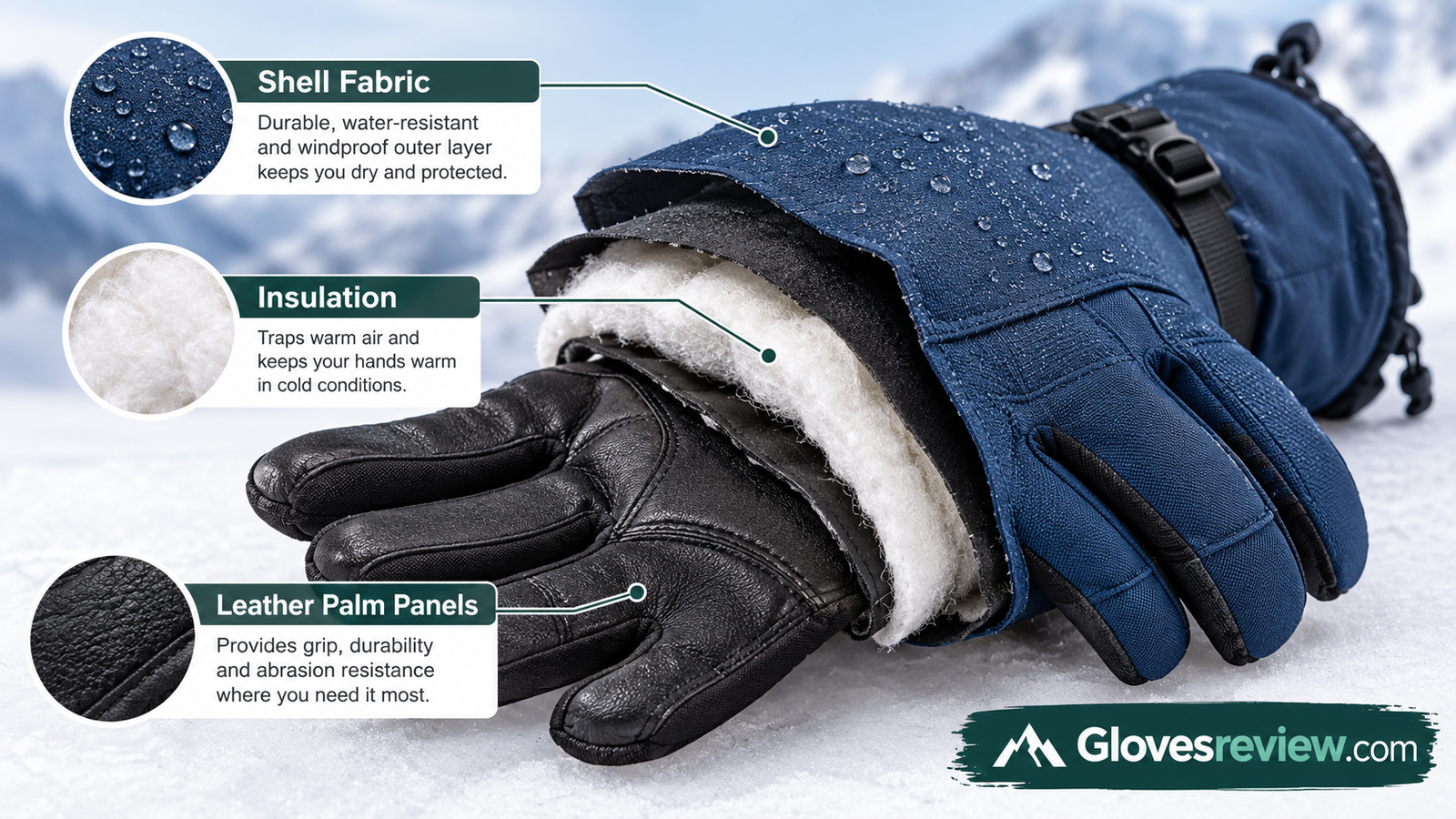
Once you see the glove as four working layers — insulation, shell, palm, and lining — plus a fit that has to be right, the buying decision stops being confusing. Ten practical steps follow, in the order experienced skiers actually use them. Work through them sequentially and the choice at the shop (or on the product page) becomes almost mechanical.
Before anything else, though, it’s worth being clear about what gloves can and cannot do. No glove generates heat — it can only slow down the heat your body already produces. If your core is cold, your hands will be cold no matter what’s on them, because the body pulls blood back toward the vital organs first. That’s why hand warmth starts with proper layering everywhere else. If chronically cold hands are your main battle, this guide on how to keep hands warm in extreme cold covers the wider system — circulation, layering, and the habits that matter more than any single pair of gloves.
How to use this guide
Steps 1 to 3 are about your body and your mountain — conditions, format and fit. Steps 4 to 8 are about materials and construction. Steps 9 and 10 cover keeping the glove alive and handling unusual situations. If you only read one thing, read the fit section: a cheap glove in the right size beats an expensive one in the wrong size, every single time.
Start With the Category, Not the Brand
Browse the full range of ski gloves first to see the spread of formats, insulation weights and cuff styles before narrowing to a specific pair.
See Current Ski Glove Options
Once the walkthrough has sharpened your priorities, use those criteria to shortlist models worth handling in person.
Match the Glove to Where and How You Ski
A glove is a weather decision before it is a gear decision.
Two skiers can buy the identical glove and have completely opposite experiences with it. One is standing still on a slow, exposed chairlift at well below freezing with a biting wind. The other is skinning uphill in damp coastal snow at barely below zero, generating heat constantly and soaking everything with sweat. The first skier needs insulation and wind blocking. The second needs breathability, fast-drying materials and a grippy wet-weather palm. Same product, different problem.
So before you look at a single spec sheet, get honest about three questions. What temperature do you usually ski in? How much of your day is spent moving versus waiting? And how often do your hands actually get wet from snow contact rather than from sweat?
Figure 1. Your dominant conditions decide which layer deserves your money first — insulation, breathability, or wind protection.
It also helps to think about output level. Lift-served resort skiing is stop-start: bursts of activity followed by long static stretches where heat loss wins. Touring and ski mountaineering are the opposite — steady output, where the enemy is moisture trapped inside the glove. A glove that is perfect for one will often feel wrong in the other, which is why many experienced skiers end up owning two pairs rather than chasing one that does everything.
Local climate shapes this more than anything else. A damp cold near freezing punishes insulation far more than a dry cold at deep sub-zero temperatures, because moisture collapses the trapped air that keeps you warm. If you ski in a wet climate, drying speed and shell performance deserve priority. If you ski in a dry continental climate, you can put your money into insulation weight and comfort instead. For a broader look at models built for each scenario, see our guide to the best ski gloves.
Find Gloves Built for Your Conditions
Filter by insulation level and shell type to match the climate you actually ski in most often.
Pick Your Format: Gloves, Mittens or Hybrids
The format of the glove sets the ceiling for warmth before any material choice is made, because it determines how much surface area your hand loses heat through. Fingers are small, high-surface-area structures with poor circulation at their tips — separating them costs warmth, and grouping them saves it.
Figure 2. Surface area drives warmth. Fewer separated fingers means less heat lost — and less ability to handle gear.
Standard Gloves
Best articulation by a wide margin. Buckles, zippers, skins and phone use are all easy. Because each finger loses heat independently, they lean harder on insulation and shell quality to stay warm.
Three-Finger Hybrids
Index finger separated, remaining fingers grouped. A genuine compromise: most of a mitten’s warmth with enough index control for the tasks that frustrate mitten wearers.
Mittens
Warmest format, without close competition. Shared fingers share heat, and the reduced surface area loses less of it. Everything from pole straps to boot buckles gets clumsier.
The honest trade-off is that no single format wins both categories, and marketing copy rarely admits it. If your hands run cold and your days are lift-served in midwinter, moving to a mitten is the single biggest warmth upgrade available — bigger than any insulation spec you could pay for. If you ski spring conditions, handle gear constantly, or value being able to work a phone without exposing bare skin, the dexterity of a five-finger glove earns its keep.
Why skiers choose mittens
- Noticeably warmer at identical insulation weights
- Fewer seams and panels to fail over time
- Less surface area for wind to attack
- Easier to layer a thin liner inside
Where mittens frustrate
- Gripping poles and adjusting bindings feels clumsy
- Using a phone usually means removing the mitten
- Fine tasks like zippers and buckles slow down
- Dexterity demands rule them out for some jobs
If you want the full breakdown of the warmth argument with the reasoning laid out, our comparison of mittens versus gloves for warmth covers when the mitten advantage is real and when it’s overstated.
Compare the Format You’re Considering
Browse gloves, mittens and hybrid designs side by side, then compare insulation within the same format for a fair read.
Get the Fit Right — Sizing and Measurement
This is the step people skip and the step that decides everything.
A well-built glove in the wrong size will underperform a cheaper glove in the right size, and no amount of spending fixes a fit problem. Too tight and the insulation compresses against your skin, killing the trapped air that keeps you warm and cutting off circulation at the fingertips. Too big and you get dead air pockets at the tips, poor grip, and a glove that’s clumsy for every task.
Figure 3. Measure your dominant hand at the knuckles and compare against the brand’s own chart — sizing varies noticeably between manufacturers.
What a correct fit feels like
- Fingers reach the end of each stall without pressing against it. If you can feel the seam at your fingertips, they’ll go cold first.
- A small gap exists when you make a fist. Insulation compresses with use, and you need a little reserve for that.
- The palm lies flat with no excess material bunching at the heel of your hand.
- The wrist closure fastens comfortably — not at maximum stretch. A glove that only fits when it’s cinched to its limit is too small.
- You can grip a pole and pinch a zipper within a minute of putting them on. If not, keep looking.
Always measure rather than trusting small/medium/large labels, which are not standardised across brands. Wrap a tape measure around your dominant hand at the knuckles, keeping your fingers together and the tape snug but not tight. Our detailed walkthrough on how to measure hand size for gloves covers both hand circumference and finger length, plus what to do if you fall between sizes.
Between sizes? The right call depends on the cuff design. Sizing up works for gauntlet styles worn over jacket sleeves, where you want room for the sleeve to tuck in. Sizing down works for thin under-cuff designs where feel and grip matter most. There’s also the question of how a glove should sit in motion, which we cover separately in how winter gloves should fit.
The most common sizing mistake
Buying a size up “to fit liners” in a glove designed to be worn alone. Oversizing creates dead air at the fingertips that makes hands colder, not warmer, and ruins grip at the same time. Liner systems are designed as matched sets — if you want layering, buy a glove built for it.
Check Sizing Before You Buy
Compare measured hand sizes against manufacturer charts and look at models with a clear size range for your fit.
Understand Insulation: What Actually Keeps You Warm
Insulation is the layer shoppers overpay for and understand least. What matters is not the brand name printed on the fill — it’s how the material behaves when damp, how much bulk it adds, how it recovers after compression, and how quickly it dries overnight.
The principle is simple: insulation doesn’t create warmth, it traps it. Still air is an excellent insulator, so every insulation type is really a machine for holding air in place. Loft, thickness and structure determine how well it does that job — and moisture is the enemy, because water conducts heat far better than air does.
Figure 4. Warmth comes from trapped air, not from the fill itself. Compress or soak that layer and the warmth goes with it.
Swipe to see more →
| Insulation type | Warmth per bulk | Behaviour when damp | Drying speed | Best suited to |
|---|---|---|---|---|
| Synthetic sheet fill | Very good | Retains warmth, resists collapse | Fast | Most skiers |
| Synthetic loose fill | Good | Good | Fast | Value-focused all-rounders |
| Down | Excellent when dry | Loses loft and clumps | Slow | Dry cold climates |
| Fleece / brushed lining | Modest | Excellent | Very fast | High-output touring |
| Foam-backed or wind-blocking | Consistent | Stable | Fast | Wind-exposed terrain |
Two practical notes about insulation specs. First, fill weight figures are only comparable within the same family of insulation — the same number printed on a sheet fill and a loose fill describes different things. Use them for rough tiering (light, mid, heavy) rather than as a precise warmth ranking. Second, thicker is not automatically warmer if it costs you the ability to grip anything. Warmth you can’t use because you’ve lost all dexterity is warmth wasted.
The fleece-versus-synthetic question comes up constantly, and the answer depends entirely on output level. We break that trade-off down properly in our comparison of Thinsulate versus fleece gloves, which is worth reading before you fixate on any particular fill branding.
- Choose synthetic fill unless you ski exclusively in dry, cold conditions.
- If you run cold, prioritise more insulation over a fancier shell.
- If you run warm or move constantly, a thinner glove plus a spare liner beats an over-insulated pair.
- Ignore brand names on the fill and judge by how the glove behaves when damp.
Compare Insulation Types Side by Side
Sort by fill style and warmth tier to find the build that suits your climate rather than the marketing claims.
Shells, Waterproofing and Breathability
The shell is the glove’s weather barrier and its structural skeleton at the same time. It decides wind resistance, water resistance, and how the glove ages through seasons of pole straps and edge scraping. It’s also where marketing language gets thickest, so it pays to understand what’s actually happening.
Figure 5. The shell blocks liquid water from outside while allowing some vapour to leave — the balance between those two jobs defines how a glove performs in real weather.
Woven synthetic shells
Nylon and polyester woven fabrics are the standard. What separates good from poor is weave density and denier on the back of the hand — the surface that meets wind, ice and lift bars. Lightweight woven shells feel lovely in a shop and can abrade quickly against hard snow and rough edges. If you’re rough on gear, look for a denser weave and consider the reinforcement coverage discussed in the next step.
Leather shells
Leather delivers the best abrasion life and grips securely when wet, which is why it dominates the palm and finger zones on serious gloves. The trade-off is maintenance: leather dries out, stiffens and cracks without periodic conditioning. For most skiers, leather where the hand works hardest and synthetic elsewhere is the best balance of durability and weight.
Waterproof membranes
A waterproof-breathable membrane laminated inside the shell keeps external water out while allowing some moisture vapour to escape. In wet snow and rain this is genuinely valuable. It also adds cost, and in genuinely dry cold it can restrict breathability without buying you anything. There’s a broader distinction worth understanding here — the difference between waterproof and water-resistant is not marketing trivia, it’s the difference between a glove that survives a wet day and one that soaks through at the worst moment. Our explainer on waterproof versus water-resistant gloves makes the line clear.
Swipe to see more →
| Shell approach | Wind resistance | Water handling | Durability | Typical trade-off |
|---|---|---|---|---|
| Woven synthetic | Good | Relies on treatment | Varies with weave | Light weight, faster abrasion |
| Woven + membrane | Very good | Waterproof build | Good | Higher cost, less vapour escape |
| Leather | Excellent | Good when treated | Best | Needs conditioning, slower drying |
| Hybrid (leather + synthetic) | Very good | Good | Excellent at wear points | Construction quality varies widely |
Honest note on waterproofing
No glove stays dry inside if your hands soak the liner with sweat, and no membrane survives being flooded at the cuff. A gauntlet that seals properly over your jacket sleeve does more for dry hands than an expensive membrane paired with a short, open cuff. If wet weather is your normal, see our picks for the best waterproof winter gloves — and if yours have stopped beading water, our guide to how to waterproof gloves brings them back to life.
Shop Waterproof & Weatherproof Builds
Compare shell constructions and cuff sealing designs for the wet, windy conditions you actually encounter.
Palms, Reinforcement and Construction Quality
If a glove fails before its time, this is where it fails.
The palm takes every scrape from poles, edges, bindings and ropes, and it’s the surface that determines how secure your grip feels. It’s also the area where budget models quietly cut corners, because reinforcement is expensive and invisible unless you know to look for it.
Figure 6. Reinforcement should wrap the palm heel, the thumb crotch and the index finger — not stop halfway across the palm.
What to look for
- Material. Goat or cow leather is the durability benchmark. Synthetic suede is lighter, cheaper and dries faster, but it wears through sooner under heavy pole and edge contact.
- Coverage. Reinforcement should wrap the thumb crotch, run down the index finger, and cover the heel of the palm. Panels that stop mid-palm leave the highest-stress seams exposed to exactly the abrasion that destroys them.
- Stitching. Double-stitched seams, ideally slightly recessed, outlast single lines that take abrasion directly. Loose thread loops on a new glove will pull out within a season.
- Articulation. Pre-curved fingers and a shaped thumb matter more than they look in a photo. A flat-cut glove fights your grip all day; a curved one feels broken in from the first run.
This is also where budget matters most honestly. The gap between an entry-level and a mid-range glove is usually invisible in the insulation spec and obvious in the palm. If you’re rough on gear — grabbing edges, hauling gear, working lifts, shovelling between storms — the same principles carry over to work-focused pairs in our guide to the best winter work gloves.
Find Gloves With Durable Palms
Filter for leather and reinforced palm builds, then compare how far the reinforcement actually extends across the glove.
Liners and Layering Systems
The lining is the layer your skin touches, and it controls moisture far more than warmth. It’s also the difference between a glove that’s usable on day two of a trip and one that isn’t.
Figure 7. A removable liner separates the moisture job from the weather job — which is exactly why it dominates multi-day trips.
Swipe to see more →
| Lining type | Strengths | Weaknesses | Best use |
|---|---|---|---|
| Fixed liner | Less bulk, better feel, no shifting parts | Slower to dry; unusable once soaked | Single-day resort skiing |
| Removable liner | Dries fast, replaceable, doubles as a spare | More bulk, some loss of dexterity | Multi-day trips |
| Removable + thin shell | Wide seasonal range, excellent layering | Requires management, easy to mismatch | Touring and variable conditions |
| Separate liner glove | Adds warmth anywhere, useful for tasks | Another item to lose, adds bulk | Backups and phone use |
The practical test is simple. If you ski single-day trips and can dry gloves on a vent at home, a fixed liner is perfectly good and slightly better to grip in. If you ski consecutive days — especially travelling, where you cannot guarantee dry gear — removable liners pay for themselves by the second morning. A damp glove on a cold dawn is the fastest route to a miserable day.
There’s a persistent myth that liner gloves are a gimmick. In practice, a thin liner worn under a proper shell adds warmth for minimal bulk, gives you a way to handle gear with one layer removed, and acts as a moisture buffer between skin and insulation. Whether they’re worth it for your setup depends on your conditions and how much dexterity you need — we unpack that properly in do glove liners work.
Compare Liner Systems
Look at removable-liner designs and standalone liner gloves to build a system rather than relying on one pair for every condition.
Cuffs, Closures and Features Worth Paying For
Cuff design is one of the most underrated decisions in the whole process. It determines how snow gets in (or doesn’t) when you fall, how the glove integrates with your jacket, and how much fumbling you do every single time you get dressed at the car.
Figure 8. The cuff is your first line of defence against snow — and the part of the glove you interact with most often.
Gauntlet
Extends over the jacket sleeve and cinches shut. Blocks spindrift, snow during falls, and wind running up the sleeve. Slightly slower to get on and off.
Under-Cuff
Sits at the wrist under the jacket sleeve. Lighter, cleaner and better for feel on poles, but snow finds its way in when you take a tumble.
Features that earn their place
- Wrist leashes or a cinch lock. Cheap, tiny, and the reason a dropped glove doesn’t vanish off the chairlift. One of the best-value additions in the category.
- A soft nose-wipe panel. Sounds trivial. Isn’t, in wind.
- Zippered vents on the back of the hand. Dump heat fast on spring days and widen the glove’s usable season.
- A cuff cinch you can work with the other gloved hand. Test this in the shop — if you can’t close it one-handed, you’ll fight it every morning.
Features that rarely justify the cost
- Overbuilt touchscreen fingertips. Conductive panels wear out and often work poorly from the start. A thin liner glove handles phones far better — see our guide to the best touchscreen gloves if phone use is a priority.
- Complex strap systems. More hardware means more parts to break while wearing gloves.
- Decoration over construction. Colourways and logos are where markup lives.
Compare Cuff Styles and Features
Browse gauntlet and under-cuff designs, and look closely at closures, leashes and venting before you choose.
Care, Washing, Drying and Re-Waterproofing
Most ski gloves die of neglect rather than hard use. A short, consistent routine will roughly double a glove’s working life, and none of it is complicated.
Figure 9. The care cycle that keeps insulation lofty, shells beading and palms supple — repeated through the season, not once at the end.
Dry them properly, every single time
Turn gloves cuff-down over a warm (never hot) vent or onto a drying rack when you get home. This is the single highest-value habit in the whole section. Crumpled gloves tossed into a boot bag stay damp internally for days, and damp insulation gradually loses the loft that makes it work.
Wash rarely, and correctly
When the shell stops beading water and starts wetting out, that’s your cue. Use a technical fabric wash rather than standard detergent, follow the label, and re-apply a durable water repellent treatment to the shell afterwards. Never use fabric softener — it coats fibres and destroys water repellency outright. Our full walkthrough on how to wash winter gloves covers what’s safe for leather, membranes and heated gloves alike.
Never apply high heat
Radiators, dryers, fireplaces and heated floors melt adhesives, shrink membranes, and turn leather hard and brittle. Gentle ambient warmth and airflow is all gloves need. If you’re stuck with soaked gloves mid-trip, the fast-drying tricks in how to dry wet gloves will get them usable by morning without damaging them.
Condition leather and store properly
Give leather palms a conditioner once or twice a season — dry leather cracks exactly at the finger creases where it flexes most. Over the off-season, store gloves flat and uncompressed so the insulation keeps its loft.
When to replace instead of repair
Worn-through palms, insulation that no longer rebounds after compression, and liners that stay clammy even after a proper wash are genuine end-of-life signs. Replacing an otherwise sound pair because the outside looks tired is usually premature — most of those shells just need washing and re-proofing.
Glove Care & Re-Proofing Supplies
Look at technical washes, water repellent treatments and drying racks that extend the life of the pair you already own.
Special Situations: Extreme Cold, Heating and Working Outside
Some situations fall outside the normal buying logic. If you spend time in genuinely punishing cold, rely on battery-powered heat, or use your gloves for labour rather than lift laps, the priorities shift.
Figure 10. Three situations where the standard buying logic shifts — each demands a different balance of insulation, power and durability.
Genuinely extreme cold
When temperatures drop far below what a resort day usually delivers, layering beats buying one enormous pair. A thin liner under an insulated shell lets you adjust as conditions change, and a gauntlet cuff stops convective heat loss up the sleeve. Mittens outperform gloves at the extremes for the reasons covered earlier, and keeping your core warm matters as much as anything on your hands. For a full cold-weather strategy, see how to keep hands warm in extreme cold.
Heated gloves
Battery-powered heating is a genuine solution for people with Raynaud’s syndrome or chronically poor circulation, and for stationary jobs in deep cold. For everyone else, the batteries, wiring and charging add cost and failure points without outperforming a well-chosen insulated glove. How the technology actually works is worth understanding before you spend — how heated gloves work explains the mechanics, while are heated gloves worth it covers the cost-benefit honestly. If you go that route, our guide to the best heated gloves is a sensible place to start.
Working outside in winter
Labour changes the priority order: abrasion resistance and grip outrank raw warmth, because a glove that wears through in weeks is no bargain regardless of its insulation. Choose tougher palm materials, expect to replace liners more often, and treat gloves as a consumable rather than an heirloom. Snow clearing has its own specific demands — we cover those in the best gloves for snow shoveling — and the broader question of staying warm through long hours outdoors is covered in how to keep hands warm while working outside.
Shop Gloves for Extreme & Working Conditions
Compare heavy-insulated, heated and reinforced work builds for the situations where standard ski gloves fall short.
Common Mistakes — and How to Spend Your Budget Wisely
After working through the ten steps, it’s worth flagging the traps that catch people most often. Almost every disappointing glove purchase traces back to one of these.
The five mistakes that cost the most
- Buying for a trip, not a season. A glove built for one extreme week you rarely experience will disappoint the other twenty weekends of the winter.
- Ignoring fit in favour of specs. Insulation weight means nothing if the glove doesn’t sit correctly on your hand.
- Chasing maximum warmth. Overheated hands sweat, wet insulation collapses, and you end up colder than a moderately insulated glove would have left you.
- Skipping palm inspection. The difference between a glove that lasts one season and five is usually the palm build.
- Never drying gloves properly. The most common cause of “my gloves stopped being warm” is simple accumulated moisture.
Where your money should go
Swipe to see more →
| Priority | Weight | What the money buys | What happens if you skimp |
|---|---|---|---|
| Fit & format | First | The right size and the right glove/mitten format | Nothing else matters; the glove gets left at home |
| Palm & construction | High | Leather palms, wrapped reinforcement, quality stitching | Seasons turn into months before the palm wears through |
| Shell quality | Medium-high | Dense weave, good treatment, real wind resistance | Wind cuts through; fabric pills and abrades quickly |
| Insulation tier | Medium | Fill appropriate to your climate and output level | Cold hands on the lift, clammy hands on the climb |
| Extras & branding | Last | Colourways, logos, rarely used features | Very little — this is where markup lives |
In practice: a well-fitted mid-range glove with a leather palm outperforms an expensive flagship with a synthetic palm that’s half a size too big. Construction quality beats price bracket, every time.
Find the Best-Built Pair in Your Budget
Compare palm materials, shell construction and fill tiers across price brackets before assuming the pricier glove is the better one.
Frequently Asked Questions
How do I choose the right ski gloves?
Work through the decisions in order: match the glove to your typical conditions, choose a format (glove, mitten or hybrid) based on how much dexterity you need, get the fit right by measuring your hand, then pick insulation and shell materials that suit your climate. Construction quality — especially the palm — should come before branding or extras.
Should ski gloves be tight or loose?
Neither. They should be snug but not compressive, with your fingertips reaching the end of each stall without pressing hard against it. A small gap when you make a fist is ideal, because insulation compresses with use. Tight gloves cut circulation and make fingertips cold; loose gloves waste heat and ruin grip.
Are mittens warmer than gloves for skiing?
Yes, almost always. Grouping the fingers together lets them share heat and reduces the surface area exposed to the cold. Three-finger hybrids narrow the gap considerably while keeping useful index control. If your hands run cold and dexterity isn’t critical, a mitten is the biggest single warmth upgrade available.
What insulation should I look for in ski gloves?
For most skiers, synthetic insulation is the sensible default — it retains warmth when damp and dries quickly. Down is excellent in dry cold but loses loft when wet. Fleece and thin brushed linings suit high-output use where sweat matters more than raw warmth. Judge insulation by its behaviour in damp conditions rather than by brand names on the label.
Do I need waterproof ski gloves?
If you ski in wet snow, coastal climates or spend a lot of time handling snow directly, yes — waterproofing pays for itself. In dry, cold continental conditions, a windproof shell with good water-repellent treatment is often sufficient and more breathable. Remember that cuff sealing and drying habits matter as much as any membrane.
How do I know my ski glove size?
Measure the circumference of your dominant hand around the knuckles with your fingers together, and compare it against the manufacturer’s own sizing chart. Sizes are not standardised between brands, so “medium” alone tells you very little. If you’re between sizes, size up for gauntlets worn over sleeves and down for thin under-cuff designs.
How long should ski gloves last?
With regular use and basic care, a well-built pair should serve you across multiple seasons. Heavy park, touring or work use wears palms faster. The palm is nearly always the first failure point, which is why reinforcement coverage deserves close inspection before you buy.
Can I wash ski gloves in a machine?
Many synthetic gloves tolerate a gentle cold wash with a technical cleaner, but always check the care label first — leather and heated gloves are usually hand-wash only. Skip the dryer entirely and air-dry open instead. High heat is what destroys adhesives, membranes and leather.
Are heated ski gloves worth buying?
For people with genuinely poor circulation or Raynaud’s, battery-powered heating solves a real problem and is worth the added weight and cost. For typical skiers, a properly insulated glove with a windproof shell is simpler, lighter and less prone to failure.
Should I use glove liners with ski gloves?
Liners work well when the outer glove is sized to accommodate them. They add warmth for minimal bulk, give you a layer to remove for fine tasks, and help manage moisture. The common mistake is oversizing a glove designed to be worn alone — that creates dead air and makes hands colder rather than warmer.
Why do my hands get cold even in expensive gloves?
Usually one of four causes: the glove is too tight and restricts circulation, the glove is too big and leaves cold air pockets, the insulation is damp from sweat or snow, or your core body temperature is low. Fixing fit and drying habits solves more cold-hand complaints than buying a warmer pair.
Ready to Choose Your Pair?
Take your answers from the questions above — conditions, format, size and budget — and shortlist gloves that match all four.
Final Word
The Pair You’ll Actually Keep Wearing
Choosing ski gloves stops being complicated once you see the glove as a small system of layers rather than a single product. Conditions decide your priorities. Format sets your warmth ceiling. Fit determines whether any of the rest matters. Insulation, shell and palm construction then let you fine-tune for your climate and how hard you are on gear. Cuff design and features finish the job — and honest care keeps the whole thing working season after season.
None of this requires buying the most expensive glove on the shelf. It requires buying the right glove for your hands and your mountain, and then looking after it. Get those things right and cold hands stop being the reason your day ends early.
Start with the format and the fit, compare construction honestly, and put your budget where the wear happens. That’s the whole method.
Find Your Next Pair of Ski Gloves
Use everything you’ve worked through — conditions, format, fit, insulation and palm build — to choose the pair that will actually get worn all season.
You May Also Like

Best Touchscreen Gloves
If staying connected on the mountain matters to you, these are the pairs whose conductive fingertips actually work.

Do Glove Liners Work?
Where liners genuinely add warmth, where they create bulk problems, and how to size a shell to accept them.

Best Gloves for Snow Shoveling
Durable, waterproof builds for the coldest hours of work — with the abrasion resistance ski gloves rarely prioritise.
Affiliate disclosure: some links on this page earn us a commission at no additional cost to you. Product details, materials and availability change frequently and may differ from what is described here; always confirm current specifications on the retailer’s product page before purchasing. This guide is general buying information, not a substitute for manufacturer instructions or professional guidance in alpine environments.