
Do Glove Liners Work? The Honest Answer About Layering Your Hands
Thin fabric, big claims. Here is what a glove liner actually does to the heat leaving your hands, where it helps, where it fails, and how to build a hand-layering system that survives real cold.
There is a particular kind of cold that shows up about forty minutes into a job: your hands are still technically covered, but the warmth has quietly leaked out through the fingertips, and everything you touch feels like it is stealing heat straight out of your blood. That is the moment people reach for glove liners — those thin, unglamorous first layers that promise to turn an ordinary winter glove into something far more capable.
The promise is easy to sell and easy to doubt. A glove liner is, after all, a very small piece of fabric. It has no insulation worth measuring in most cases, no waterproofing, no shell. So do glove liners work, or are they just a comfort accessory dressed up as gear?
The honest answer is more useful than a simple yes or no. Glove liners do work — measurably and consistently — for three specific reasons: they add a thin but real layer of trapped air, they manage the moisture your hands produce (which is the hidden engine behind most “my hands are freezing” complaints), and they let you keep some insulation on your skin during all the small tasks where you would otherwise be bare-handed. What they do not do is turn a thin city glove into an expedition mitt. Understanding the difference is the whole game.
In this guide we will walk through the physics of hand heat loss, the different liner fabrics and what each one is genuinely good at, the situations where liners shine and the situations where they waste your money, and how to size, layer, wash, and combine them so the system works as one piece instead of a pile of mismatched fabric.
What Glove Liners Actually Are
Strip away the marketing and a glove liner is a simple thing: a thin, close-fitting glove designed to be worn against the skin, underneath something else. It is usually made from silk, merino wool, a synthetic microfiber, a lightweight fleece, or a stretch knit blend. It is almost never waterproof. It is almost never thick. Its entire job is to sit in the space between your skin and the rest of your gear and quietly do the work that the outer glove cannot.
That last point matters. Most people picture warmth as a property of a glove, when it is really a property of a system. The outer glove provides structure, wind resistance, water resistance, and the bulk of the insulation. The liner provides the first contact layer — the layer that decides what happens to the thin film of warm, humid air your skin produces every second it is alive.
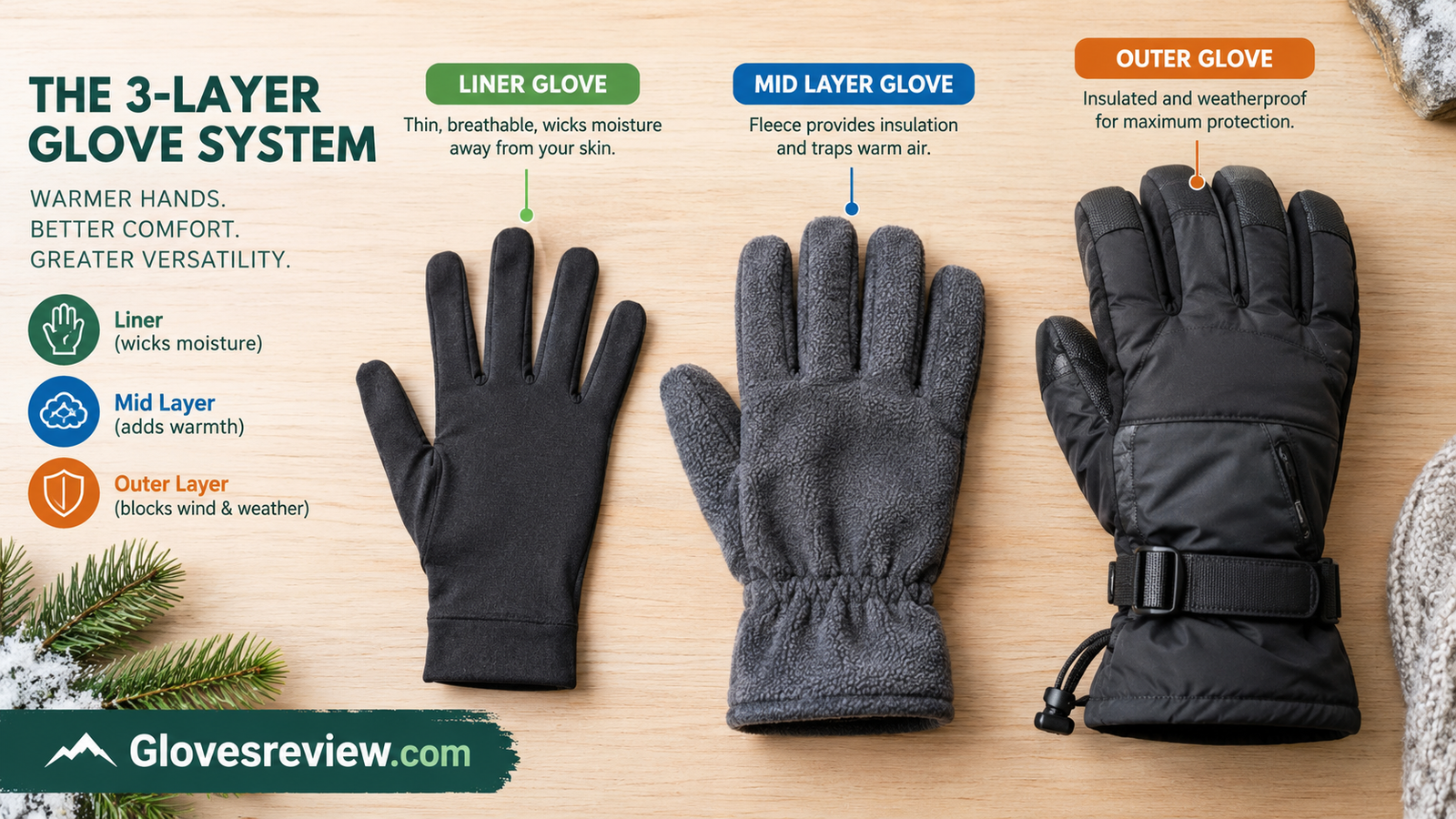
The hand layering model: shell, insulation, liner, skin. Remove any one of them and the others compensate badly.
Liners existed long before they were sold as accessories. Cold-weather militaries have issued them for generations as part of a modular clothing system, precisely because a thin extra layer is the cheapest, lightest way to extend the range of gear a soldier already carries. Mountaineers arrived at the same logic from a different direction: if you carry a thin liner and a shell, you can reconfigure your hands as conditions change without carrying four pairs of gloves.
Modern liners add a few refinements on top of that idea. Flat-locked seams prevent pressure points inside an already snug glove. Extended cuffs cover the wrist gap where warm air escapes. Some carry conductive fingertips so you can use a phone without exposing bare skin. A few are laminated against wind. Some are electrically heated, which blurs the line between a liner and a whole glove, but the principle is identical: the liner is the layer that touches you.
A glove liner is a thin, close-to-skin layer worn under a glove or mitten to add insulation, manage moisture, and preserve warmth during brief periods when the outer glove must come off. If a product is thick, insulated on its own, and designed to be worn alone, it is a glove — not a liner.
It is also worth defining what a liner is not. It is not a waterproof barrier. It is not a cure for a glove that is too small. And it is not a substitute for circulation — if your hands are cold because blood is not reaching them, no amount of fabric fixes that. Keep those boundaries in mind and the rest of this article will make a great deal more sense.
Looking for the Right Liner Weight?
From silk ultralights to warm merino knits.
Browse the full range of glove liners.
How Your Hands Lose Heat — and Where a Liner Fits In
To judge whether liners work, you have to look at what is actually happening to your hands in the cold. Heat leaves the body through four routes: conduction (touching something cold), convection (wind or moving air carrying warmth away), radiation (heat simply radiating off a warm surface), and evaporation (moisture turning to vapour and taking heat with it). Gloves address all four, but they address them unevenly, and that unevenness is exactly where a liner earns its place.
Conduction: everything you touch is stealing heat
Pick up a metal shovel handle at minus ten and the pain is conduction. Air is a poor conductor of heat; metal is an excellent one; water sits somewhere in between and is roughly the worst thing that can happen to a hand covered by fabric. A liner helps with conduction by keeping a fabric barrier between your skin and any cold surface that presses through the outer glove, and by adding another interface where heat must slow down before it escapes.
Convection: wind strips the boundary layer
Your skin is wrapped in a thin film of warm air. Sit still in still air and that film does a surprising amount of insulating. Add wind and it is stripped away continuously, which is why a glove that felt fine on the porch feels useless on a moving snowmobile. A liner adds an extra trapped-air layer inside the glove, so even when the outer fabric is being battered by wind, there is still a warm pocket next to your skin.
Radiation: the slow, constant leak
A warm hand radiates infrared energy in every direction. Thick insulation works mainly by reflecting and reabsorbing that energy within a deep loft of trapped air. A thin liner cannot do much against radiation on its own, but it does reduce the direct radiative loss from bare skin to a cold inner glove surface, which is a small but real gain.
Evaporation: the one people underestimate
Hands are among the most sweat-dense areas of the human body, and they sweat even when you feel cold. That moisture does two kinds of damage. First, evaporation is a cooling process — every gram of water turning to vapour takes heat out of your hand with it. Second, damp fabric loses its insulating value dramatically, because water conducts heat away from skin far faster than the air it replaced.
This is the part of the story that makes liners genuinely useful rather than merely comfortable. A liner sits exactly where the moisture is produced. If it is made from the right material, it pulls that moisture off your skin and spreads it through the outer glove, where it can escape. Your hand stays drier, the insulation stays drier, and the whole system performs closer to its intended rating.
Why hands get cold before the rest of you
There is also a physiological reason hands fail first. Blood vessels in the fingers are arranged so warm arterial blood passes close to cold venous blood returning from the extremities, transferring heat back toward the core before it is lost. When your body senses cold, it constricts the vessels in your hands and feet to protect core temperature. The result: your fingers get cold, then colder, and adding insulation to a hand with almost no warm blood arriving is a losing fight.
Which leads to the first practical rule of hand layering: put the liner on before your hands get cold. A liner is a preventive tool. Once your fingers are already icy, the fix is activity, a warm drink, a heat pack, or getting out of the wind — not a thin extra layer.
If you routinely struggle in deep cold, our full guide on how to keep hands warm in extreme cold covers the whole-body side of the equation, because warm hands start at your core.
Build a Better Base Layer for Your Hands
Thin liners that trap air without bulk.
Find the right weight for your climate.
Do Glove Liners Actually Work? What the Evidence Says
Here is the direct answer, followed by the nuance that makes it useful. Yes, glove liners work. A properly fitted liner worn inside a correctly sized glove will keep your hands warmer than the same glove worn alone, and it will do so in a way you can feel within minutes. The gain is not imaginary and it is not just psychological. You are adding an insulating layer of still air and improving moisture handling, and both of those are measurable physical effects.
The size of the gain depends on four variables, and this is where most confusion begins:
- The fit of the outer glove. A liner only helps if there is room for it. If the outer glove is already snug, adding a liner compresses both layers, and compressed insulation loses much of its trapped air. In that case a liner may make your hands colder, because it pushes blood flow away from the fingertips and reduces loft.
- The fabric of the liner. Silk and merino add warmth while handling moisture well. Cotton adds nothing and actively makes things worse when damp. Thin polyester is comfortable but modest in warmth. The material decides whether the layer helps or just fills space.
- The conditions. In cold, dry, windy weather, a liner adds a meaningful comfort buffer. In wet conditions where water is coming through the shell from outside, the liner gets saturated like everything else and stops helping.
- Your own circulation and activity level. Someone shovelling vigorously is generating heat; someone standing at a bus stop is not. A liner extends range for both, but the absolute warmth depends heavily on blood flow and output.
Swipe to see more →
| Situation | Does a Liner Help? | Why | What Works Better |
|---|---|---|---|
| Cold, dry, windy day | Yes — noticeably | Extra trapped air layer inside the wind-protected glove | Liner plus a windproof shell |
| Glove is one size too tight | Usually not | Compression removes loft and restricts circulation | Size up the glove, then add the liner |
| Wet snow soaking through the shell | Only briefly | A saturated liner stops insulating | Waterproof outer glove; see best waterproof winter gloves |
| Frequent on/off tasks | Yes — a lot | Skin never goes fully bare to the air | Liner plus a mitt with a quick-release cuff |
| Static work in deep cold | Moderately | Adds range, but cannot compensate for low circulation | Insulated mitts, hand warmers, heated gloves |
| Hands already frozen | No | Insulation traps cold, not warmth, when blood flow is cut | Warm up indoors first, then layer |
It is worth being precise about the type of improvement people report, because it is consistent. Wearers rarely say “my hands were tropical.” They say their hands stayed comfortable for longer, the chill took far longer to set in, the fingertips did not go numb as quickly, and — importantly — the agony of putting a cold glove back on disappeared. That last benefit is underrated. The liner stays warm against your skin, so the glove never feels like a slab of cold leather going back on.
There is also a comfort-versus-survival distinction that honest testing surfaces. A liner is not going to keep a photographer’s hands warm at a static stakeout in severe cold on its own. But across a working day of variable activity — in and out of gloves, indoors and outdoors, gripping tools and then holding a coffee — the difference between a bare inner glove and a liner is the difference between functional hands and hands you stop feeling.
Glove liners reliably add warmth and comfort when the outer glove has room for them and the shell keeps outside water out. They are an upgrade to a good system, not a rescue for a bad one.
So if you came here with a single question — do glove liners work — the answer is yes, with the system conditions spelled out above. Everything after this point is about making sure you get the version of “yes” instead of the version where you spent money and felt nothing.
Test It Yourself This Season
A decent liner costs less than most gloves.
It is the cheapest upgrade in cold-weather gear.
Types of Glove Liners, Compared Side by Side
Not all liners are equal, and the differences are not subtle once you have worn each kind for a full day. The fabric determines warmth, moisture behaviour, durability against pilling, feel against skin, and how the liner behaves when it eventually gets wet. Here is the landscape.
Silk liners
Silk is the classic lightweight liner, and it earns the reputation. It is remarkably warm for its thickness, it feels smooth against skin, and it slides easily into a tight glove without bunching. Silk also handles moisture reasonably for a natural fibre, absorbing some dampness without immediately feeling clammy. The trade-offs are durability and care: silk abrades over time against rough glove interiors, and it prefers gentle washing. For commuters, photographers, and anyone who wants warmth without losing finger feel, silk is still an outstanding choice.
Merino wool liners
Merino is the workhorse of the modern lineup. It insulates even when damp, which is a genuine safety property in cold weather, and it resists odour across multiple days of use — a real advantage on trips. Merino liners range from very thin knits to midweight versions that add substantial warmth. They handle moisture by absorbing vapour into the fibre while still feeling dry to the touch, which keeps the microclimate next to skin stable. The downsides: merino can feel slow to dry, it can pill if the yarn is fine and the use is rough, and good merino is not the cheapest option.
Synthetic microfiber liners
Polyester and nylon microfibers are the value and durability play. They dry faster than anything natural, they are tough, they wash easily, and they are usually the most affordable. Their weakness is warmth-to-weight — a thin synthetic liner adds less warmth than the same thickness of merino — and they can hold odour more readily unless treated. For high-output activity where sweat is the main enemy and the outer glove already does the insulating, synthetic is arguably the smarter pick.
Fleece liners
Lightweight fleece is warmer and bulkier than everything above. Fleece traps a great deal of air and stays comfortable against skin, and it is inexpensive. The problem is volume: fleece eats into the space inside your glove, so it only works if the outer glove is roomy. Fleece also wicks less effectively against the skin than a fine knit, and in very high-output use it can go damp and stay that way. If you want to understand where fleece sits against other insulating fabrics, our comparison of Thinsulate vs fleece gloves lays out the trade-offs clearly.
Windproof and softshell liners
These are laminated liners with a wind-blocking membrane. They solve a specific problem: the outer glove is warm but drafts find their way in at the cuff or through the shell. A windproof liner converts that glove into a much colder-weather tool without adding much bulk. They are less breathable than open knits, so in high-output use they can trap sweat — best paired with a breathable shell.
Heated liners
Electrically heated liners place thin heating elements along the fingers and back of the hand, powered by a small rechargeable battery. They are the only type that adds energy instead of merely conserving it, which makes them the answer for people with poor circulation or genuinely severe conditions. They cost more, add a little bulk at the cuff, and need charging. We keep detailed guides on the best heated gloves, how heated gloves work, and whether heated gloves are worth it if you want to go deeper on that route.
Swipe to see more →
| Liner Type | Warmth | Moisture Handling | Dexterity | Best For |
|---|---|---|---|---|
| Silk | Good for the thickness | Absorbs moderately, feels smooth | Excellent | Commuting, photography, tight gloves |
| Merino wool | Very good, works damp | Excellent vapour handling | Very good | Multi-day use, variable conditions |
| Synthetic microfiber | Moderate | Wicks fast, dries fastest | Excellent | High output, wet work, budgets |
| Fleece | Very good | Slower to move vapour | Good (bulkier) | Roomy gloves, static cold |
| Windproof laminate | Good plus wind protection | Moderate | Good | Wind, snowmobiles, exposed ridges |
| Heated | Best — adds active heat | Depends on fabric shell | Good | Severe cold, poor circulation |
What about cotton?
It deserves its own paragraph because it is still common. Cotton liners feel lovely when dry and become a liability the moment they get damp, holding moisture against the skin and losing almost all insulating value. In cold weather that is not a comfort issue; it is a safety issue. If a liner is going to see sweat, snow, or repeated glove removal, choose anything except cotton.
Start With Silk or Merino
The two most reliable liner materials.
Compare options in the most popular weights.
How Much Warmer Do Glove Liners Actually Make You?
People want a number here, and the honest answer is that warmth is not a single number — it is a system property. But the direction and rough magnitude of the effect are easy to describe once you understand how insulation works.
Insulation is not magic and it is not a material property so much as an air property. What keeps you warm is still air trapped in fibres, loft, and the gaps between layers. Air conducts heat poorly, so every additional pocket of trapped, unmoving air between your skin and the outside adds resistance to heat flow. Stacked layers of insulation add up — two thin layers generally outperform one thick layer of the same total material — but only if those layers stay lofty. Squeeze the air out and the warmth leaves with it.
A liner does not create heat. It slows the rate at which the heat your body already produces leaves your hand.
Applied to hands, that means a liner adds a modest but genuinely perceptible increase in total insulation. In practice, wearers describe the effect as extending the comfortable range of an existing glove — often turning “adequate for an hour” into “comfortable for an afternoon.” It is the difference between a glove that works until conditions shift and a glove that keeps working when they do.
Three factors that swing the result more than the liner itself
- Dead air space. A liner that fits like a second skin traps a thin, uniform layer of air. A liner that is baggy creates circulating air pockets where convection quietly moves heat around and out.
- Compression. The moment a liner presses against the shell, both layers lose loft. This is why sizing up the glove when you plan to use liners is standard advice rather than a sales trick.
- Dryness. A damp liner contributes far less insulation than a dry one. Managing moisture — which is the topic of the next section — does more for warmth than choosing a slightly thicker fabric.
Layering math for hands
The common model people carry in their heads comes from clothing: a base layer, a mid layer, a shell. Hands follow the same logic, with the caveat that fingers are thin, hard to insulate evenly, and prone to losing circulation. A typical cold-weather hand system looks like this: a thin liner against skin, an insulated glove or mitt as the mid and shell, and — if the weather demands it — an overmitt for wind and wet.
When people ask whether two liners beat one, the answer is usually no. Two liners compress each other, reduce dexterity, and can restrict blood flow at the fingers. It is almost always better to add warmth with a loftier outer glove than with extra layers against the skin. If you want the extreme-cold version of this system, our guide to keeping hands warm in extreme cold covers heat packs, circulation, and mitt strategy.
And one comparison that comes up constantly: for the same level of insulation, mittens versus gloves for warmth is not close — shared-finger volume holds more warm air. A liner inside a mitt is one of the warmest hand setups you can build.
Add a Warmth Layer Without Losing Feel
Midweight liners that fit under your existing gloves.
Wider range, same dexterity.
Dexterity, Grip and Touchscreen Use: The Trade-Off Nobody Mentions
Warmth is the headline, but dexterity is the reason many people keep wearing liners long after they stop thinking about them. Every additional layer between your skin and the world costs you tactile feedback. The thicker the glove, the worse you are at picking up a small bolt, feeling a zipper pull, handling a camera dial, or tying a knot. Liners are the tool that buys some of that feel back.
Here is the useful mental model: insulation and dexterity are competing demands, and a liner shifts the balance in your favour because it lets you solve the warmth problem with a thin, close-fitting layer instead of a thicker, clumsier glove. You can then choose an outer glove for the conditions rather than for the task, and strip down to the liner alone for the moments that need fingers.
What a good liner gets right
- Seam placement. Flat seams, ideally positioned away from the finger pads and knuckles, so nothing presses into the skin inside a tight glove.
- Snug fingertip fit. Excess fabric at the fingertips is what kills fine motor work and touchscreen accuracy.
- Grip treatment. Silicone dots or printed grip patterns on the palm and fingers help with tools and phones, especially in wet conditions.
- Conductive fingertips. Conductive yarn in the index finger and thumb lets capacitive screens register your touch without removing gloves.
- Low-bulk cuff. A thin cuff disappears under the outer glove rather than bunching at the wrist.
Touchscreens: how well do liners actually work?
Well, when they are designed for it, and poorly when they are not. Capacitive screens respond to the electrical properties of skin, so any non-conductive fabric between your finger and the glass breaks the signal. Conductive-thread tips restore it — but only if the tip contacts the screen cleanly and the fabric is not bunched. Real-world performance is good enough for tapping, typing short messages, and swiping maps. It is rarely good enough for precise photo editing or small UI elements, and worn conductive tips degrade over time.
If phone use is a daily requirement, it is worth looking at a dedicated outer layer as well; our roundup of the best touchscreen gloves covers gloves built entirely around that problem.
Grip in wet and cold conditions
Grip is quietly the most dangerous thing to get wrong. A cold, stiff glove over a slippery inner surface means dropped tools, dropped shovels, and fumbled carabiners. Liners improve grip in two ways: the fabric itself has a higher coefficient of friction against skin than most smooth glove linings, and many carry printed grip patterns. On top of that, a warmer hand simply works better — cold fingers lose strength and coordination before you notice the loss.
When you buy liners, buy them one weight thinner than you think you need and check the fit at the fingertip first. A liner that reaches the end of your finger cleanly gives you far more usable dexterity than a warmer one with a centimetre of loose fabric at every tip.
Fit is where this section and the sizing section meet. If the liner is too long in the fingers, every fine task feels clumsy and every touchscreen tap misses. If it is too short, it pulls at the fingertips and cuts circulation in the cold. Our guide on how to measure hand size for gloves is worth reading before you order, and how winter gloves should fit explains what correct fit feels like in practice.
Keep Your Fingers Working
Touchscreen-compatible liners for phones and tools.
Thin, warm, and screen-ready.
Moisture Management: The Liner’s Hidden Job
If you take one idea away from this entire article, take this one. The most valuable thing a glove liner does is often not adding warmth — it is managing the water your hands produce. Warmth follows from that almost automatically.
Your hands sweat in the cold. They sweat when you work, when you grip, when you walk uphill, and even when you are anxious about being cold. That sweat has to go somewhere. In a single-layer glove it condenses on the inside of the shell and soaks into the insulation. In a layered system with a proper liner, it is pulled into the liner fabric, spread across a much larger surface area, and driven outward toward the shell where it can evaporate.
How each liner fabric behaves when damp
Swipe to see more →
| Fabric | What It Does With Sweat | Feels Like When Damp | Drying Speed |
|---|---|---|---|
| Merino wool | Absorbs vapour into the fibre, keeps skin feeling dry | Warm, not clammy | Slow to moderate |
| Silk | Absorbs some moisture, remains smooth | Cooler once saturated | Moderate |
| Synthetic microfiber | Wicks liquid fast across a wide area | Damp but not sodden | Fast |
| Fleece | Holds air well, moves vapour slowly | Can feel clammy under load | Moderate |
| Cotton | Traps moisture against the skin | Cold and clinging | Very slow |
The “wet equals cold” rule is relentless. Water pulls heat away from the body far faster than air does, which is why a damp liner in wind feels dramatically worse than a dry one. It is also why getting the moisture out of your gloves at the end of the day is not housekeeping — it is gear maintenance that directly affects your warmth tomorrow.
Keeping the outside out
There is a second half to the moisture story, and it is about water coming in. Snow, slush, and rain will overwhelm any liner if the shell above it is soaked. This is the one place where a liner genuinely cannot help you, and where the outer glove does all the work. The distinction between a water-resistant and a waterproof shell is the difference between a glove that handles an hour of wet snow and one that handles a day of it; our explainer on waterproof versus water-resistant gloves covers exactly where the line falls.
For genuinely wet work, pair your liner with an outer glove built for it. Our guide to the best waterproof winter gloves is the natural next read if slush and rain are your usual conditions.
What to do when everything gets wet anyway
It happens. You fall through a crust of snow, the cuff goes under, or you work with wet ropes for three hours. The recovery process matters more than people expect. Do not blast gloves with direct heat — high temperatures damage membranes, shrink wool, and can melt synthetic fibres. Instead, remove the liner, wring it gently, and dry both pieces slowly in moving air. We have a complete walkthrough on how to dry wet gloves without destroying them.
If the outer glove is losing its ability to shed water — which happens to every shell eventually — reproofing restores it. Our guide to how to waterproof gloves covers which treatments work on which fabrics.
Beat Sweat Before It Beats You
Fast-wicking liners that keep insulation dry.
The easiest upgrade for long days outside.
When Glove Liners Work Best: The Situations That Reward Layering
Liners are not a universal upgrade. They are a targeted one, and the activities below are where the payoff is largest — usually because those activities combine cold, variable effort, and frequent glove removal.
Skiing and snowboarding
This is arguably the ideal liner environment. You alternate between hard effort and lift rides where your hands cool down fast. You need dexterity for buckles, zips, passes, and phones. You generate sweat on the descent and then sit still in wind. A liner handles all of it: it adds warmth on the chairlift, keeps your hands dry on the run, and lets you sort out a boot buckle without bare fingers. If you are buying the rest of the system, our guides to the best ski gloves and how to choose ski gloves cover the outer layer in depth.
Outdoor work in winter
Trades, delivery, landscaping, warehouse loading, farm work — anything with tools and a lot of on-off cycles. The pattern is always the same: thick gloves for warmth, then you take them off to handle a small part, then your hands cool, then you fight to get a cold glove back on. A liner breaks that cycle completely. Combined with a durable outer glove, it is the standard setup for anyone working outside all day. See our picks for the best winter work gloves and our advice on keeping hands warm while working outside.
Snow shovelling and driveway clearing
Short, intense, and often done in the worst available weather with wet snow. Liners help here because shovelling alternates between heavy work and pauses, and because you will absolutely need bare fingers at some point for a lock, a phone, or a garage keypad. A good pairing is a thin liner under a waterproof, grippy glove. We have a dedicated guide to the best gloves for snow shoveling if that is your main winter battle.
Commuting and city winters
Cold platforms, warm trains, cold again. The temperature swings are the challenge rather than the absolute cold. Liners let you carry one glove system instead of two, and they keep your hands warm when you are standing still waiting for transport — the scenario where most gloves fail.
Photography, birdwatching and fieldwork
Anything that requires fine control in the cold. Photographers have used thin silk or merino liners under loose mitts for decades: mitt down for the shot, mitt up between frames, fingers never fully exposed. It works because the outer layer is chosen for warmth and the liner is chosen for feel.
Hunting, fishing and shooting sports
Long periods of stillness punctuated by moments that demand complete control. The standard solution is a liner plus a heavy mitt that can be dropped and retained on a lanyard, with hand warmers in the mitt for the static stretches.
Running and cycling in the cold
High output means sweat is the main enemy rather than ambient cold. Here a thin, fast-wicking synthetic liner under a windproof glove is usually the perfect balance — enough warmth at speed, no clamminess at the finish.
Choose liners when your day involves variable effort, frequent glove removal, and cold that is dry or only moderately wet. That combination describes most real winter days.
Ready for the Slopes or the Driveway?
Find liners sized for your outer gloves.
Comfortable all day, warm all season.
When Glove Liners Don’t Help — and What to Do Instead
An honest article has to cover the failure modes. There are real situations where buying a liner will leave you disappointed, and knowing them in advance saves money and discomfort.
1. The outer glove is already too small
This is the single most common failure. A liner worn inside a snug glove compresses the insulation of both, forces your fingers against the ends of the fingers, and squeezes the small blood vessels that keep your fingertips alive. People report hands getting colder after adding a liner, and the liner gets blamed. The problem is the glove. Buy the outer glove with room for a liner — ideally try the two together before committing.
2. Water is coming in from outside
A liner cannot protect you from a shell that is soaked through. In wet snow, driving rain, or slushy handling work, the shell decides your fate. Fix the shell first, and treat liners as a layer for inside that shell only.
3. The conditions exceed the whole system
A liner adds range; it does not add unlimited range. In genuinely severe cold with low activity, no thin layer will compensate for the fact that your body has already restricted blood flow to your hands. The correct answer there is a heavily insulated mitt, active heat, or both. If you go the powered route, our guide to the best heated gloves explains what is available and how the heating systems differ.
4. Your hands are already cold
Insulation slows heat loss. It does not create heat. If your fingers are already numb, a liner will simply trap cold air against them. The fix is core warmth, movement, warm fluids, and getting out of the wind — then layer up once circulation is restored.
5. Poor-quality liners that bunch or pill
Cheap liners with rough seams, inconsistent knitting, or loose cuffs slide and bunch inside the glove. Bunched fabric creates pressure points, cuts circulation, and feels worse than wearing nothing. Quality in liners is mostly about fit consistency and seam construction, not about exotic materials.
6. Circulation conditions such as Raynaud’s
When the fingers overreact to cold by cutting off blood flow, insulation alone is often not enough. Liners still help as part of a wider strategy — keeping the whole body warm, avoiding tight cuffs, using hand warmers, and considering active heat — but they are one piece of that plan rather than the solution. Anyone with a diagnosed circulation condition should talk to a clinician about a cold-exposure plan.
7. Regulated or certified work gloves
Some protective work gloves are certified as a complete unit, and adding anything inside them can change the fit and, in some cases, the protective performance. If your gloves are issued PPE with a specific standard, check with the manufacturer or your safety officer before adding liners.
Liners shine when…
The glove fits with room to spare, the shell sheds water, and you are in and out of your gloves all day.
Liners fail when…
The glove is tight, the shell is soaked, your hands are already numb, or the cold is beyond what the system was built for.
It is also worth asking whether the alternative is simply a different glove rather than a liner. If you are constantly layering to fix a warmth shortfall, the outer glove may be the wrong tool. Mitt designs hold more warm air than gloves for the same insulation, and understanding that trade-off is why we published a full comparison of mittens versus gloves for warmth.
When Liners Aren’t Enough
Explore windproof and heavily insulated options.
Built for the days that defeat thin layers.
How to Choose the Right Glove Liner
Choosing a liner is mostly an exercise in matching fabric, fit and thickness to what you actually do in winter. The following checklist will get you to a good choice quickly.
Step one: decide the primary job
- More warmth from an existing glove → midweight merino or fleece, provided the glove has room.
- More dexterity with frequent glove removal → thin silk or synthetic microfiber.
- Sweat control during high output → synthetic microfiber or a fine merino knit.
- Wind cutting through the shell → windproof laminate liner.
- Medical-grade cold intolerance → heated liner or heated glove system.
Step two: get the fit right
The liner should feel like a second skin. No slack at the fingertips, no bunching at the palm, no pressure anywhere. Cuffs should extend past the wrist so there is no exposed gap when you reach overhead. If you are between sizes, choose the smaller size for liners (unlike outer gloves, where you size up to allow layering).
Sizing guidance matters more than people expect here: how to measure hand size for gloves gives you the numbers you need before ordering, and how winter gloves should fit shows what good fit looks like on the outer layer.
Step three: choose the weight
Swipe to see more →
| Weight | Feel | Best Paired With | Watch Out For |
|---|---|---|---|
| Ultralight | Barely noticeable, maximum finger feel | Snug gloves, cool to moderate cold | Adds little warmth alone |
| Lightweight | Thin but present | Most winter gloves, active use | Check fingertip length carefully |
| Midweight | Noticeable cushioning | Roomy gloves, static cold | Needs glove volume |
| Expedition | Thick, warm, less dexterous | Large mitts and overmitts | Overkill for everyday use |
Step four: check the details
- Flat or welded seams rather than raised stitching over the knuckles and finger pads.
- Conductive fingertips if phone use matters to you.
- Grip prints on the palm if you handle tools, poles, or steering wheels.
- Machine-washable construction — liners get washed constantly and must survive it.
- Reinforced fingertips if you will use them with rough glove interiors.
- Odour-resistant treatment or naturally odour-resistant fibre for multi-day use.
Step five: think about the pair, not the product
The liner and glove are a system. Try them together, move your fingers, grip something, and check that your fingertips reach the ends. If you want to see what a properly fitted glove system feels like from the outside in, start with a well-regarded outer layer and build in; our guide to the best winter work gloves is a good reference point for glove construction quality.
Buy the liner for your task and the glove for your weather. If both are chosen for the same reason — usually warmth — you will end up over-layered and clumsy.
Compare Liner Styles in One Place
Silk, merino, synthetic, fleece and heated.
Find the fit and weight that suits you.
Building the Hand-Layering System — and Keeping It Working
A liner performs as part of a stack. Get the stack right and the individual products behave exactly as advertised. Get it wrong and even good gear feels mediocre. Here is how to assemble it, and how to keep it performing across a full season.
The three-layer hand system
- Contact layer (liner). Thin, snug, moisture-managing. This layer decides comfort and dexterity.
- Insulation layer. Loft that traps warm air. In most gloves this is built into the outer glove, but in extreme systems it can be a separate insulated glove worn over the liner.
- Shell layer. Wind and water protection. This is a separate overmitt in severe conditions, or the outer fabric of a standard glove.
The key is not to overstuff. If your fingers press against the ends of the glove, or your hand feels tight when you make a fist, the system is over-filled and will be colder than a thinner, properly fitted alternative.
Caring for your liners
Liners live in the worst possible environment — constant sweat, friction, and washing — so care matters more here than with almost any other piece of gear.
- Wash frequently. Body oils and salt degrade fibres and reduce wicking performance. A gentle machine wash in cool water is fine for most synthetics and merino.
- Skip fabric softener. It coats fibres in a waxy film and destroys wicking ability — the one thing you bought the liner for.
- Dry gently. Air drying is best; if you must use heat, keep it low. High heat shrinks wool and damages elastic.
- Dry the shell too. The liner and the glove must both be dry before storage, or mildew and odour follow.
- Rotate pairs. Owning two liners means one is always dry, which is the single biggest comfort upgrade available for very little cost.
Full washing instructions live in our guide to how to wash winter gloves, and drying technique is covered in detail in how to dry wet gloves. If your outer shell stops shedding water, our guide to how to waterproof gloves will bring it back to life before you replace it.
Seasonal storage
At the end of the season, wash both liner and glove, dry them thoroughly, and store them uncompressed in a dry place. Do not leave gloves jammed in a boot or a vehicle footwell where they stay damp and get crushed flat — loft that is compressed for months may not fully recover.
When to replace
- Pilling that creates friction and reduces the fit.
- Thinning at the fingertips, which is where warmth leaks first.
- Loss of elasticity in the cuff, letting cold air in.
- Conductive tips that no longer register on screens.
- Persistent odour that survives washing — a sign the fibre has degraded.
Two pairs of liners, washed weekly in season and dried fully, will outperform one expensive pair treated carelessly. Warm hands are mostly a maintenance habit.
Keep a Dry Pair Ready
Most people never think to own a spare.
It is the cheapest comfort upgrade there is.
Myths, Common Mistakes — and Are Glove Liners Worth the Money?
Let us clear the folklore out of the way before the final verdict, because several persistent myths cause people to buy the wrong thing.
Myth: thicker always means warmer
Thicker means more potential insulation, but only if the loft is maintained and the fit allows circulation. A thick liner inside a tight glove is colder than a thin liner inside a roomy one. Thickness without volume is just compression.
Myth: any thin glove works as a liner
Not really. Liners are cut for a purpose: close fit, flat seams, correct cuff length, and fabric chosen for skin contact. A thin fashion glove usually has seams and linings that create pressure points when layered.
Myth: liners make any glove subzero-ready
A liner extends the range of a glove. It does not change the category of that glove. A glove rated for cool weather stays a cool-weather glove with a slightly larger comfort margin.
Myth: cotton liners are fine because you are indoors most of the time
The problem is not ambient temperature; it is moisture. A damp cotton liner in moving air is a cooling device strapped to your hand.
Myth: liners are only for serious outdoor athletes
The biggest everyday beneficiaries are commuters, dog walkers, parents on a cold sideline, and anyone who wears gloves for an hour at a time. The casual use case is where the comfort-per-dollar ratio is highest.
The mistakes worth avoiding
- Buying the liner and glove as separate afterthoughts instead of a matched pair.
- Ignoring the fingertip fit, which governs dexterity more than fabric does.
- Wearing liners until they are sodden and assuming the outer glove will compensate.
- Layering two liners and losing circulation in the process.
- Using fabric softener on technical fibres.
- Waiting until hands are cold to put the system on.
So: are they worth it?
On pure value, glove liners are among the best returns in cold-weather gear. They cost far less than a new pair of gloves, they extend the life and usefulness of the gloves you already own, they solve the “hands get cold when I take my gloves off” problem outright, and they improve moisture handling in every system. The main risk is buying the wrong weight or fit, which is why the sizing and pairing advice above matters more than the brand name on the label.
They are worth it if you spend real time outside in winter, if your gloves are decent but not quite enough, or if you are constantly removing gloves for tasks. They are less compelling if your hands are warm already, if you own a glove that is genuinely built for deep cold and fits you perfectly, or if the real problem is wet-weather gear — in which case fix the shell first and read our guide to the best waterproof winter gloves.
Make Your Gloves Work Harder
One small layer, one noticeable difference.
Find your liner weight today.
Frequently Asked Questions About Glove Liners
Do glove liners really keep your hands warmer?
Yes. A fitted liner adds a thin layer of trapped air and improves how moisture moves away from your skin, and both effects reduce heat loss. The improvement is most noticeable when the outer glove has room for the liner and the shell keeps outside water out. If the glove is already tight, a liner can actually make your hands colder by compressing insulation and restricting blood flow.
Are silk glove liners warm enough on their own?
In cool weather, yes — silk is remarkably warm for its weight and works well as a standalone light glove for tasks like photography or handling a phone. In genuine cold, silk is best treated as a base layer under an insulated glove, because it offers no wind or water protection by itself.
Can you wear glove liners with any gloves?
Almost any glove with some internal room will accept a thin liner. Very snug gloves, slim leather gloves cut close to the hand, and tightly insulated gloves designed for a precise fit may not. Always try the combination together and check that your fingertips still reach the ends of the glove.
Do glove liners go inside or outside the glove?
Inside, directly against your skin. That is the entire point — the liner manages the microclimate at the skin surface and adds a layer of still air beneath the insulation. Wearing a liner over a glove only works in the specific case of a windproof or waterproof overmitt, where the liner is functioning as the insulating mid layer.
Are merino wool liners better than fleece?
For most people, yes. Merino handles moisture better, stays comfortable when damp, resists odour, and fits closer to the skin so dexterity is preserved. Fleece is warmer per thickness and cheaper, but it is bulkier and slower to move vapour. Choose fleece for roomy gloves in dry cold, and merino for everything else.
Do glove liners help with sweaty hands?
They do, and it is one of their strongest benefits. A wicking liner pulls moisture away from the skin and spreads it through a larger area, so it can pass through the outer glove instead of soaking the insulation. Synthetic microfiber and fine merino knits are the best performers for high-output use.
Can you use touchscreen devices with glove liners?
If the liner has conductive fingertips, yes — for tapping, swiping, typing short messages and reading maps. Accuracy depends on fit and how worn the conductive tips are. Plain liners of any material will not operate a capacitive screen at all.
How should glove liners fit?
Like a second skin. No slack at the fingertips, no bunching in the palm, and no tightness at the wrist. Liners run smaller than outer gloves, so if you are between sizes, size down for the liner and up for the glove. A long cuff that covers the wrist is a real advantage.
Do glove liners help with Raynaud’s or poor circulation?
They can be part of a strategy, but they are not a complete answer. Because circulation conditions are driven by blood flow rather than insulation alone, the best results come from combining liners with whole-body warmth, loose cuffs, hand warmers, and in some cases heated gloves. Speak to a clinician about managing cold exposure safely.
Can you wear glove liners under waterproof gloves?
Yes, and it is one of the best combinations available — a wicking liner inside a waterproof, insulated glove handles both sweat and outside water. Just make sure the waterproof glove has enough internal volume that the liner is not compressed against the shell.
How do you wash glove liners without ruining them?
Cool, gentle machine wash or hand wash, mild detergent, absolutely no fabric softener, and air drying away from direct heat. Washing liners often actually extends their useful life by removing salts and oils that break down fibres and block wicking. Full instructions are in our guide on how to wash winter gloves.
Are heated glove liners worth it?
For people who work or spend long hours in severe cold, or who have cold-intolerant hands, heated liners deliver something no passive layer can: added energy. They cost more, need charging, and add some bulk at the cuff. For occasional winter use, a good merino or silk liner will give you most of the benefit at a fraction of the price.
Do Glove Liners Work? Yes — When You Let Them
So, do glove liners work? Yes. They work by doing three quiet jobs at once: adding a layer of trapped air between your skin and the cold, moving sweat away before it can soak your insulation, and keeping some warmth on your hands during all the small tasks that would otherwise leave them bare. That is a real, physical, measurable benefit — not a marketing story.
They work best inside a glove with room to spare, under a shell that keeps water out, in a day where you are moving between effort and stillness and taking your gloves off constantly. They work less well in a tight glove, in soaking wet conditions, or when your hands are already cold. In those cases, the fix is a different outer layer, better waterproofing, or active heat — not another thin piece of fabric.
Match the fabric to the job, get the fit right at the fingertips, wash them properly, and keep a dry pair in your bag. Do those four things and you will feel the difference the first cold morning you use them, and you will keep using them long after you have forgotten this article existed.
Get the Right Liner for Your Winter
Silk, merino, synthetic, fleece and heated options.
Compare styles and find your fit today.
Mittens vs Gloves for Warmth
Which design holds heat better, and when the dexterity trade is worth making.
Best Heated Gloves
When passive insulation is not enough, powered warmth changes the equation.
How Do Heated Gloves Work?
Heating elements, battery systems and what the specs really mean for warmth.
Are Heated Gloves Worth It?
Where powered gloves pay off, and where a good liner plus a warm shell wins.
How to Keep Hands Warm While Working Outside
Layering, breaks, warmers and habits that keep your hands functional all shift.
Best Ski Gloves
Warmth, waterproofing and dexterity for lift rides, boot buckles and long days.
This article is for general information and outdoor comfort guidance. Product availability and specifications change over time, so always check current manufacturer information before purchasing. If you have a circulation condition or work with protective equipment requirements, consult a qualified professional about cold exposure and certified glove systems.