How Should Winter Gloves Fit? A Zone-by-Zone Guide to Getting It Right
Fit is the difference between gloves that keep you warm and gloves that quietly let the cold in. Here is exactly how each part of the glove should sit on your hand.
The Most Expensive Mistake in Winter Gear Is a Sizing Mistake
Every winter, thousands of people buy a genuinely excellent pair of gloves, put them on, and discover that their fingers are still cold by lunchtime. The insulation is good. The shell is windproof. The reviews were glowing. So what went wrong?
Nine times out of ten, the answer is fit. Not the brand, not the insulation weight, not some mysterious personal failing of the wearer’s circulation — just a glove that is slightly too tight in the fingers, or a cuff that never quite seals at the wrist, or a pair sized for bare hands that is now being worn over a liner it was never designed to accommodate.
Fit is the quiet variable that decides whether all the other engineering on the glove actually works. Insulation needs trapped air to do its job, and trapped air needs room. Circulation needs to reach your fingertips without being squeezed along the way. Grip works best when your hand is not fighting the glove. And wind and snow need a continuous, closed barrier from your sleeve to your fingertips — one gap undoes the rest.
Yet almost nobody teaches this properly. Sizing charts are inconsistent between brands, the fitting room mirror tells you nothing about how a glove behaves at minus ten with a cold wind, and the temptation is to buy the pair that looks warmest rather than the pair that fits the way it should.
So let’s fix that. This guide walks through how a winter glove should fit on every part of your hand, how to measure yourself accurately, what the size labels actually mean, and how to diagnose and repair the fit problems that make people give up on an otherwise good pair.
The Short Answer
A winter glove should fit snugly across the palm and the base of the fingers, with a small amount of room at the fingertips — roughly enough to pinch a little loose fabric without the finger sliding around. Your fingers should reach close to the ends without pressing against them, your knuckles should flex without the glove riding up, the thumb should move freely through its gusset, and the wrist should close firmly with no gap to the sleeve. If your fingertips tingle, go pale or go numb, the glove is too tight. If the glove twists when you grip or your fingers feel like they are swimming, it is too loose.
- What a correctly fitted glove feels like at each zone of the hand
- A simple measuring method you can do at home with a tape measure
- How insulation, liners and activity change the size you need
- The five-minute dexterity test to run before you commit
- A troubleshooting table for cold fingers, slipping gloves and gap cuffs
Start With a Properly Sized Pair
Browse winter gloves with full size ranges and fit guidance.
Check Price on AmazonWhy Fit Matters More Than Insulation
It sounds counterintuitive. Surely warmth comes from insulation, and insulation comes from thickness? Yes — but only if that insulation is doing its job, and fit is what allows it to.
Insulation does not create heat. It slows down the escape of heat your body is already producing, and it does that by trapping tiny pockets of still air within its fibres. That is the whole mechanism. Compress those fibres and you squeeze the air out of them, and the insulation becomes dramatically less effective. This is exactly what happens when a glove is too tight: the very material that is supposed to keep you warm is being crushed against your skin.
The second mechanism is circulation. Your fingers are at the far end of a long supply line, and when the body is cold it constricts blood vessels in the extremities to protect your core. Add a tight glove cuff, a squeezed palm or a finger tube that is too narrow, and you are helping that constriction along. Warm blood cannot reach tissue it is being squeezed away from. This is why so many people report that a bigger, looser glove feels warmer than a snug one — the extra room restored blood flow.
What a Correct Fit Actually Delivers
- Loft preservation. Insulation keeps its full thickness instead of being flattened against the skin.
- Unrestricted circulation. Blood reaches the fingertips without being throttled at the palm or wrist.
- Efficient grip. Your hand closes naturally instead of fighting fabric, so you grip more lightly and stay warmer.
- A continuous barrier. Cuff, wrist and fingers form one unbroken shield against wind and snow.
- Accurate touch. Zips, buckles, keys and screens respond to what your fingers are actually doing.
- Less sweat. A glove that fits properly is easier to vent and less likely to trap heat until you perspire.
There is also a comfort dimension that matters more than it sounds. A glove that rubs at the thumb, rides up when you reach or twists when you grip becomes a constant low-grade irritation. Over a long day outdoors that distraction adds up, and people start doing the thing that makes everything worse — taking their gloves off.
Fit is also the reason the same pair of gloves can feel completely different on two people, and the reason a pair that felt perfect in a warm shop becomes a problem on the mountain. Temperature, moisture and activity all shift how the materials behave, which is what the rest of this guide deals with. If you are heading into genuinely harsh conditions rather than an ordinary cold commute, our guide to how to keep hands warm in extreme cold covers the wider system around the glove.
Build a Warm System From the Start
Shop winter gloves designed with room for layering.
Check Price on AmazonToo Tight, Just Right, Too Loose: Reading the Fit Spectrum
Almost every fit complaint falls into one of three categories. Learning to recognise which one you are dealing with saves you from buying yet another pair to fix a problem you could have solved in ten seconds.
Swipe to see more →
| What You Feel | Too Tight | Just Right | Too Loose |
|---|---|---|---|
| Fingertips | Pressing against the end, tingly or pale | Close to the end with a small soft pinch of fabric | Noticeable empty space past the fingertips |
| Palm | Squeezed, hard to open the hand fully | Contact without compression, no loose folds | Baggy fabric bunched when you grip |
| Knuckles | Binding when you make a fist | Flexes cleanly, glove stays in place | Glove slides and rotates when you close your hand |
| Thumb | Pulls tight across the web | Free pivot with no tension in the gusset | Thumb stalls in extra fabric |
| Wrist and cuff | Circulation feels restricted when fastened | Firm seal, one finger of ease, no gap to the sleeve | Gap you can see daylight through |
| Overall feel | Colder, not warmer | Forget you are wearing them | Clumsy and drafty |
Why “Size Down for Feel” Backfires
- Compressed insulation loses much of its trapped air
- Fingertip pressure restricts blood flow exactly where you need it
- Reduced dexterity because your hand fights the glove
- Seams and membranes are stressed, shortening the glove’s life
- Colder in practice than a roomier pair from the same range
Why “Size Up to Be Warm” Backfires
- Cold air circulates in the dead space at the fingertips
- Grip becomes imprecise, so you squeeze harder and tire your hand
- Glove rotates around the hand when you pull or lift
- Bulk catches on zips, tools and door handles
- Fine tasks become slow and frustrating
One important nuance: mittens follow the same logic but with different geometry. Because the fingers share a chamber there is more internal volume to play with, and the fit priorities shift toward the wrist and the palm rather than individual fingertips. If you are deciding between the two formats in the first place, our comparison of mittens vs gloves for warmth covers how each one behaves on the hand.
Find Your Fit Sweet Spot
Shop gloves with stretch panels and adjustable wrist closures.
Check Price on AmazonZone by Zone: Where Each Part of the Glove Should Sit
“How should it fit?” is really six smaller questions. A glove can be perfect at the palm and still fail at the cuff, and the overall sensation will be “these don’t work” rather than anything specific. Diagnosing by zone makes the problem obvious.
1. The Fingertips
This is the single most useful checkpoint. Slide your hand in and press the pad of your thumb to the tip of each finger in turn. You should be able to feel a small amount of soft fabric beyond your fingertip — enough to pinch gently, not enough for the finger to slide around. Fingertips that press hard against the end will go cold first and lose feeling first. Fingertips swimming in fabric lose the dexterity that makes gloves worth wearing.
2. The Knuckles
Make a fist slowly, then open your hand wide. The glove should follow both movements without binding across the back of the hand and without creeping up toward the wrist. Stretch panels across the knuckles help enormously here, particularly in stiff, heavily insulated models. If the glove rides up when you reach overhead or forward, it is short in the fingers or tight across the back of the hand.
3. The Palm
The palm should have full contact with no loose folds when your hand is relaxed, and no compression when you grip. Excess palm fabric is what makes a glove feel clumsy on a ski pole, a shovel or a steering wheel. Too little, and you are back to restricting circulation and grip strength. Leather and synthetic palm panels often have less stretch than the back of the hand, so this zone deserves particular attention.
4. The Thumb Gusset
The piece of fabric between thumb and hand is under constant stress and is a common failure point. It should let your thumb pivot and oppose your fingers without tension. If you feel the glove pulling across that web every time you grip, the glove is too small for your hand shape — and that is a shape problem, not just a size problem.
5. The Wrist
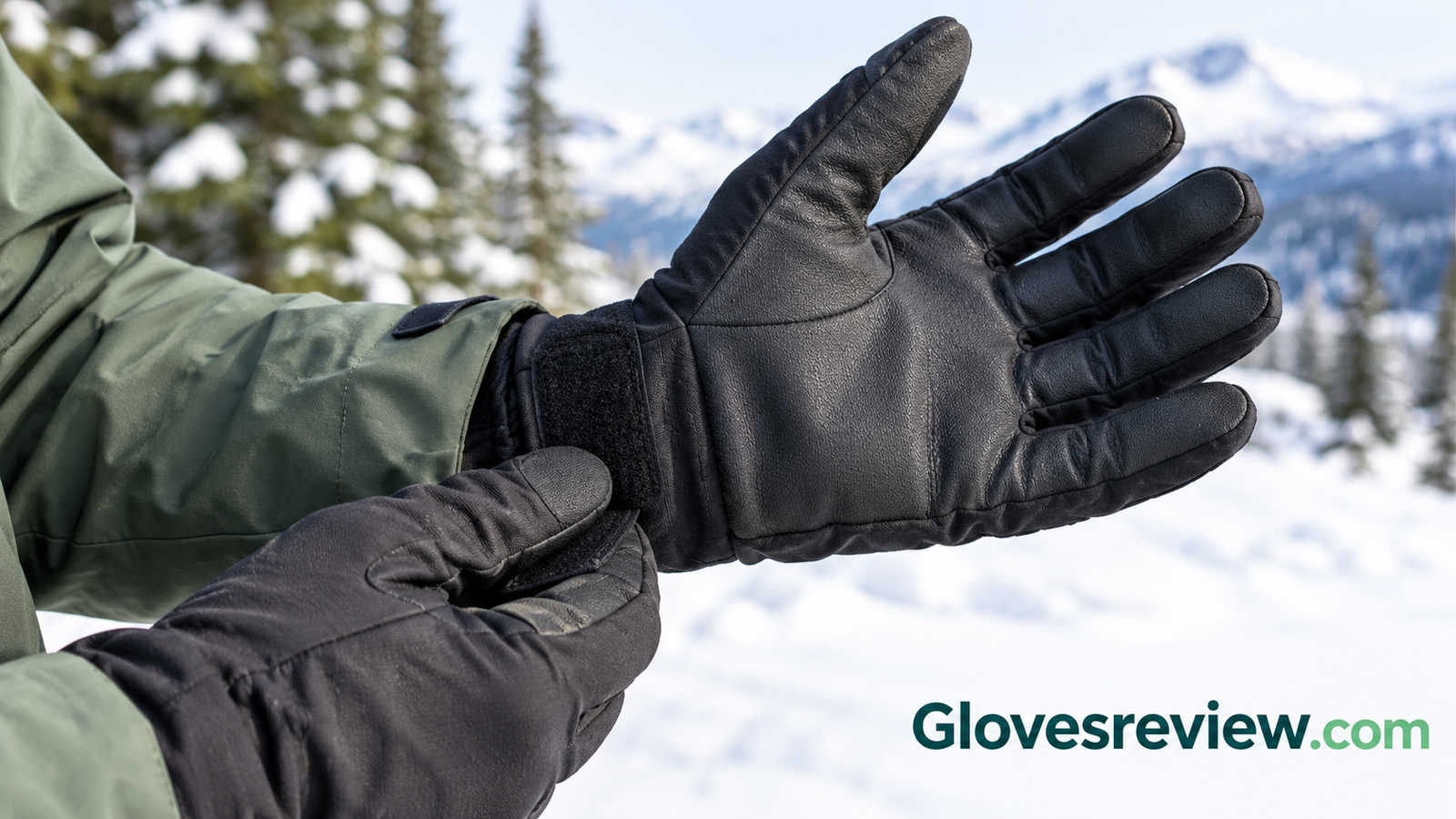
Fasten the wrist closure until it is snug, then check that you can still slide one finger underneath it comfortably. That is your seal. Too loose and the glove becomes a bellows, pumping cold air in every time you move. Too tight and you are compressing the very vessels that supply your fingers. An adjustable closure — strap, cinch or elastic — is worth prioritising over almost any other feature.
6. The Cuff
The cuff should overlap your jacket sleeve, not sit under it and not leave a strip of bare wrist. Gauntlet-style cuffs that go over the sleeve block snow and wind; short cuffs that tuck in look neater but leak in bad weather. If you wear a watch, make sure the cuff can close over it without pressure.
Zone rule of thumb: when something feels wrong, identify which of the six zones is responsible before you assume the whole glove is the wrong size. Often the fix is as simple as loosening the wrist or choosing a model with a longer finger pattern.
Gloves That Fit Better by Design
Shop models with pre-curved fingers, stretch panels and cinch wrists.
Check Price on AmazonHow to Measure Your Hand Properly Before You Order
Guessing your glove size from your shirt size, your shoe size or what you wore ten years ago is the fastest route to a return. Ten minutes with a soft tape measure removes nearly all of the uncertainty from buying online, and it also gives you a number you can compare across brands.
Step 1: Measure Hand Length
Hold your hand flat with fingers together and the palm facing up. Run the tape from the crease at the base of your wrist straight up to the tip of your middle finger. Keep the tape flat against the skin without pulling it tight. This number drives most size charts and is the one to trust when a brand gives only one measurement.
Step 2: Measure Palm Circumference
Wrap the tape around the widest part of your hand — across the knuckle line, excluding the thumb. Keep your hand relaxed and the tape snug but not squeezing. This number matters more for heavily insulated and technical gloves, where the palm volume sets how much room there is for liners and movement.
Step 3: Measure Your Dominant Hand
Most people’s dominant hand is slightly larger, so measure both and use the larger of the two numbers. If one hand is meaningfully bigger, look for brands that sell individual sizes rather than fixed pairs, or size to the larger hand and accept a slightly easier fit on the smaller one.
Step 4: Decide What You Are Wearing Underneath
Measure again with the liner you intend to wear, or simply add the thickness to your expectation. A thin merino liner changes the fit very little; a thick fleece liner changes it a great deal. Sizing a pair for bare hands and then forcing a liner underneath is one of the most common reasons people end up with cold fingers.
Step 5: Compare Against the Brand’s Own Chart
Always let the manufacturer’s chart override your assumptions. Different brands cut their patterns differently — some are long and narrow, others short and wide — and the same nominal size can fit two people very differently. Your own measurements are the input; the brand chart is the translation layer.
The Measuring Checklist
Soft tape measure (or a strip of paper and a ruler) · Both hands measured · Palm measured without the thumb · Notes taken in both inches and centimetres · The liner you plan to wear accounted for · The brand’s chart in front of you.
We go into considerably more detail — including how to measure without a tape measure and how to handle stubborn half sizes — in the full guide to how to measure hand size for gloves.
Put Your Measurements to Work
Shop winter gloves with detailed size charts and easy returns.
Check Price on AmazonSizing Charts Demystified: What the Labels Actually Mean
Glove sizing is a mess, and it is not your imagination. The same person can be a medium in one brand and a large in another. Some charts use letters, some use numbers, some use both, some quote palm circumference and some quote hand length, and a surprising number publish nothing useful at all.
The table below is a rough ball-park of how adult glove sizes are commonly mapped to hand measurements across the industry. Treat it as an orientation tool, not as a brand’s official chart — when a manufacturer publishes its own numbers, those win.
Swipe to see more →
| Size Label | Palm Circumference (ball-park) | Hand Length (ball-park) | Typical Fit Notes |
|---|---|---|---|
| XS | roughly 6.5–7 in (16.5–17.8 cm) | under about 6.5 in (16.5 cm) | Often the hardest size to find in technical ranges |
| S | roughly 7–8 in (17.8–20.3 cm) | roughly 6.5–7 in (16.5–17.8 cm) | Common for smaller adult hands and many women’s cuts |
| M | roughly 8–9 in (20.3–22.9 cm) | roughly 7–7.5 in (17.8–19 cm) | The size most people default to — and most often get wrong |
| L | roughly 9–10 in (22.9–25.4 cm) | roughly 7.5–8 in (19–20.3 cm) | Frequently the right call for liner layering |
| XL | roughly 10–11 in (25.4–27.9 cm) | roughly 8–8.75 in (20.3–22.2 cm) | Watch finger length; some brands cut short in the fingers |
| XXL | above roughly 11 in (27.9 cm) | above roughly 8.75 in (22.2 cm) | Availability varies widely between brands |
These ranges are indicative only. Hand proportions, brand patterns and insulation thickness all shift where you land. When a brand publishes a chart, use that chart.
Why the Same Size Fits Differently Between Brands
- Pattern block. Every manufacturer drafts from a different hand model. Some are long and narrow; others are short and wide.
- Intended use. A slim running glove and a bulky ski mitten can both be called “large” while fitting nothing alike.
- Insulation thickness. Heavily insulated models need more internal volume, so a “large” is often built roomier than a “large” in a liner.
- Gender and age cuts. Women’s and children’s patterns differ in proportion, not just in scale — shorter fingers relative to palm width, for instance.
- Materials. Stretch woven backs move with you; leather and stiff membranes barely give at all.
- Regional sizing. Charts quoted in centimetres, European numbers or alpha letters do not always translate cleanly.
Signs a Brand Gets Sizing Right
- Publishes both hand length and palm circumference
- Offers half sizes or multiple width options
- States whether the glove is sized for layering
- Provides photos of the glove on a model with stated size
- Has a straightforward exchange policy
Warning Signs
- Only a single vague measurement given
- Sizing described purely as “true to size”
- No mention of whether liners are accounted for
- Reviews consistently mentioning the glove runs small or large
- Final-sale policies on gloves
Half sizes are worth taking seriously. If you sit between two labels, the decision usually comes down to whether you layer. Bare-handed wearers can size down toward the snugger label; anyone planning a liner underneath should size up toward the roomier one.
Shop With Confidence
Compare gloves with clear, detailed size charts before you buy.
Check Price on AmazonFit Changes With the Type of Glove
A glove designed for a specific job fits differently from a general winter glove, and expecting all of them to feel the same is a reliable way to end up disappointed. Here is how the main categories differ on the hand.
Swipe to see more →
| Glove Type | Should Feel | Common Fit Mistake | Fit Priority |
|---|---|---|---|
| Resort ski glove | Snug on the palm, room for a liner, long gauntlet | Buying too small because it “looks better” | Control on poles plus warmth on the lift |
| Work glove | Close fit with strong articulation at the fingers | Ignoring finger length and thumb web | Grip, feel and durability |
| Liner glove | Almost second-skin, no loose fabric anywhere | Buying liners too large because they are thin | Contact with skin and dexterity |
| Running / cycling glove | Close and aerodynamic, minimal bulk | Over-sizing for warmth and losing bar feel | Wind protection and grip |
| Touchscreen glove | Snug enough that conductive tips touch the screen | Loose fingertips causing missed taps | Tip contact and precision |
| Mitten | Roomy chamber, firm wrist seal | Sizing too tight and killing the shared heat | Volume and cuff closure |
| Heated glove | Enough room for elements and a battery pocket | Buying a snug size and compressing the heating panels | Internal volume and cable routing |
Ski and Snowboard Gloves
On the mountain you alternate between gripping poles and sitting still on a lift, so the glove has to do two jobs. The palm needs to be close enough for a confident pole grip, while the back of the hand and fingers need enough volume for insulation and often a liner. Gauntlet cuffs matter more here than almost anywhere else, because snow finds every gap when you fall.
Fit is one of the first things we evaluate when comparing mountain handwear — see our guide to the best ski gloves — and the practical checkpoints for choosing a pair are laid out in how to choose ski gloves.
Work and Utility Gloves
For manual work, fit is a safety issue as much as a comfort one. A glove that twists on a tool handle or dulls your grip on a ladder is actively dangerous. Look for close finger fit, a solid palm panel, and articulation at the knuckles so your hand does not fatigue. Expect to replace work gloves more often — the palm and fingertips take the punishment.
Heated Gloves
Heated models add heating elements, wiring and usually a battery pocket, all of which consume internal space. Sizing them as tightly as an ordinary glove compresses the panels against your hand and can create hot spots. Give them the room the manufacturer asks for, and make sure the battery pocket does not dig into your wrist when you flex.
Fit and heat output are closely linked in these designs, which is why we look at internal volume and element placement in our roundup of the best heated gloves.
Match the Glove to the Job
Shop ski, work and technical gloves sized for real use.
Check Price on AmazonInsulation, Liners and the Fit Equation
Nothing changes the fit of a glove faster than adding something underneath it. Liners are the cheapest and most effective upgrade in cold-weather handwear, but they are also the reason so many people end up between sizes.
How Liners Change the Numbers
A thin liner adds very little bulk and usually fits inside a correctly sized glove without drama. A thick fleece or pile liner adds real volume and can push you a full size up. The temptation is to buy the glove first and add a liner later; the smarter sequence is to decide on your layering system first and then size for it.
Swipe to see more →
| What You Wear Underneath | Effect on Fit | Sizing Approach |
|---|---|---|
| Nothing | Baseline — maximum feel, minimum volume | Buy true to your measured size |
| Thin silk or synthetic liner | Minimal change, useful moisture management | Usually true to size |
| Merino liner | Slight added volume, noticeable warmth gain | True to size if the glove is roomy; up one if it is snug |
| Thick fleece or pile liner | Significant volume, easy to overfill the glove | Size up, and choose a glove designed for layering |
| Chemical heat pack | Consumes space at the back of the hand or palm | Size up and use a mitt or roomy glove |
Choosing Between Liner Materials
Merino Liners
- Warm and comfortable against skin
- Continue to insulate when damp
- Naturally resist odour over multi-day use
- Excellent for fine tasks worn alone
Synthetic Liners
- Thinner for the same level of dexterity
- Wick moisture quickly away from the skin
- Dry faster after a hard, sweaty effort
- Often cheaper to replace when worn out
If you are weighing insulation types inside the glove as well as under it, the pairing of a microfibre insulation with a fleece liner is the most common setup — and the differences between them are worth understanding before you spend. We break that down in Thinsulate vs fleece gloves, and we tested whether liners genuinely make a measurable difference in do glove liners work.
The Layering Fit Rules
- Decide your system first, then buy the outer glove to suit it
- Never compress the liner — that is when a liner makes you colder
- Check the fingertip pinch test again with the liner actually in place
- Keep the liner close to the skin; loose liners bunch and rub
- Make sure the wrist can still close properly over the liner cuff
- Carry a spare liner — they weigh almost nothing and save the day
Complete Your Layering System
Shop merino and synthetic glove liners that fit under winter gloves.
Check Price on AmazonThe 60-Second Dexterity Test You Should Always Run
Before you commit to a pair — in a shop or after an online delivery — spend one minute doing what you will actually do in them. Almost every fit problem reveals itself immediately, and it is far easier to exchange a pair on day one than to live with a compromise all season.
The Six Movements
- Make a fist, then open wide. Repeat slowly several times. The glove should move with you, not fight you, and must not ride up toward the wrist.
- Pinch and pick up. Try picking up a coin, a key or a zip pull. This exposes fingertip length and palm bulk instantly.
- Grip something solid. Hold a pole, a bottle or a door handle. The glove should stay put and the grip should feel secure without squeezing hard.
- Use your phone. If the glove claims touchscreen compatibility, test every fingertip. Loose tips cause missed taps and endless frustration.
- Reach overhead and forward. Gloves that fit fine at chest height often ride up and expose the wrist when you stretch.
- Fasten and unfasten. Work a jacket zip, a buckle and a wrist strap. These small tasks are what make a pair feel livable day to day.
What a Good Fit Feels Like
- You forget the glove is on within a minute
- Fine tasks take only slightly longer than bare-handed
- The glove stays put when you grip and pull
- No pressure points at the fingertips or thumb web
- Wrist closes firmly without feeling tight
What Should Send Them Back
- Tingling or colour change in the fingertips
- Glove rotates around the hand when gripping
- You cannot feel objects through the palm
- The cuff will not close without pinching
- Seams dig in at the thumb or between the fingers
Grip and dexterity matter more in some activities than others. If your winter revolves around clearing snow, hauling bins, handling tools or working outdoors for hours at a time, the fit requirements are considerably more demanding than for casual wear — our roundup of the best winter work gloves covers the constructions that hold up to that kind of use.
One More Test Worth Doing
Wear the gloves for ten minutes indoors before you take the tags off. Hands warm up, materials soften and any hidden pressure point will announce itself. Anything that bothers you at ten minutes will be unbearable at two hours.
Test Before the Cold Does
Shop gloves with the grip and articulation you need.
Check Price on AmazonFixing the Most Common Fit Problems
Most fit complaints have a straightforward cause and an inexpensive fix. Work through the table below before you assume the gloves are a write-off.
Swipe to see more →
| The Problem | Likely Cause | The Fix |
|---|---|---|
| Cold fingertips | Glove too tight at the fingers, or cuff too loose | Size up, loosen the wrist slightly, add a thin liner |
| Numb or tingling fingers | Compressed circulation at the palm or wrist | Stop and warm up; change to a larger size immediately |
| Hand slides forward | Glove too long in the fingers | Choose a shorter finger pattern or a size down |
| Glove twists when gripping | Too much palm volume | Size down, or pick a model with a grippier, closer palm |
| Draft at the wrist | Cuff too short or closure worn out | Choose a gauntlet cuff; layer the cuff over the sleeve |
| Sweaty hands | Over-insulated for the activity, or non-breathable shell | Wear less insulation while moving, use a wicking liner |
| Pain at the thumb web | Glove too small for your hand shape | Change pattern, not just size; look for a gusseted thumb |
| Touchscreen misses | Loose fingertips or worn conductive tips | Size for tip contact; replace when the coating wears |
When the Problem Is Not Fit
Fit is the most common culprit, but it is not the only one. If your hands are cold in a pair that fits perfectly, look at the wider system. Are you dressed warmly enough through your core? Are you dehydrated or under-fed? Is the insulation damp from yesterday? Are you standing still for hours when the glove is designed for activity? Each of these can produce exactly the same symptoms as a sizing error.
Take Numbness Seriously
Fingertips that turn white, waxy or hard, or that lose feeling entirely, are beyond the scope of a sizing fix. Get out of the cold, rewarm gradually in body heat or comfortably warm water, do not rub the area, and seek medical attention if colour and sensation do not return normally. Fit problems should never be tolerated to the point of injury.
If you have sorted the fit and your hands are still cold, the issue usually lies in moisture, activity level or layering rather than the glove itself. Our guide to how to keep hands warm while working outside works through those variables one by one.
Solve It Before the Next Cold Snap
Shop adjustable-fit gloves built for changing conditions.
Check Price on AmazonBuying Online vs Trying Them On in Store
Both routes work, and both fail in predictable ways. The trick is knowing what each one is good at and covering the gap yourself.
Pros of Trying In Store
- Immediate feedback on fingertip length and palm volume
- You can run the dexterity test on the spot
- Easy to compare two sizes side by side
- You can feel insulation thickness and cuff design directly
- No return shipping or waiting
Cons of Trying In Store
- Warm indoor conditions flatter almost any glove
- Selection is often limited to a narrow size run
- Pressure to decide on the day
- Hard to test with the liner you actually plan to use
- Prices are frequently higher than online
Pros of Buying Online
- Full size runs, including very small and very large
- Access to detailed brand size charts and user feedback
- Wider range of technical constructions
- Time to measure properly and think it through
- Better pricing and easier comparison
Cons of Buying Online
- You cannot feel the fit before committing
- Sizing varies between brands in ways charts do not capture
- Return shipping can be slow in peak season
- Photographs rarely show fit proportions honestly
- Easy to be seduced by features over fit
The Online Ordering Checklist
Before You Click Buy
- Measure both hands and record the larger measurement.
- Open the brand’s own size chart and follow it rather than guessing.
- Decide whether you will wear a liner, and size accordingly.
- Read reviews specifically for fit comments — “runs small” is gold dust.
- Check the return and exchange policy before ordering.
- If you are between sizes, order both if the policy allows and return one.
- Keep the tags on until you have run the indoor ten-minute test.
Review comments are the closest thing to a real fitting room online. Look past the star ratings and search the text for words like “snug”, “long in the fingers”, “tight across the knuckles” or “room for a liner”. Those details predict fit far better than any headline number.
Order With a Measuring Tape in Hand
Shop gloves with generous size ranges and clear charts.
Check Price on AmazonHow Fit Priorities Shift With the Activity
The “right” fit is not a fixed target. It moves depending on what your hands are doing, how much heat they generate and how long they stay still. Here is how to weight your priorities.
Swipe to see more →
| Activity | Fit Priority | What to Look For |
|---|---|---|
| Snow shovelling | Grip and dexterity first | Close palm, articulated fingers, room for a thin liner |
| Working outside for hours | Durability and sustained comfort | Reinforced palm, secure wrist, no pressure points |
| Resort skiing | Control plus lift-line warmth | Snug palm, roomy back of hand, gauntlet cuff |
| Winter hiking | Breathability and layering | Sizing that accommodates a liner and a shell |
| Commuting and driving | Feel and quick on-off | Snug fit, short cuff, easy closure |
| Photography or hunting | Precision at the fingertips | Close tip fit, or a flip-back / three-finger design |
| Extreme cold, low activity | Volume and sealing | Size up for liners and heat packs, full gauntlet cuff |
Shovelling and Physical Work
When your hands are working hard you generate plenty of heat, so the enemy is not the cold — it is sweat, bulk and loss of grip. Fit should be close and precise, and insulation should be moderate. A glove that is too big for shovelling will slip on the handle and force you to squeeze, which tires your hands and cuts circulation. Our shortlist of the best gloves for snow shoveling focuses on exactly this combination.
Static Cold
Standing at a bus stop, watching a match, waiting for a lift — your hands produce very little heat and the priority flips entirely toward volume, sealing and layering room. This is where the temptation to over-tighten does the most damage. Keep the wrist sealed but not squeezed, and leave room for liners or a heat pack.
Extreme Conditions
In genuinely brutal cold, fit is part of a wider survival strategy rather than a comfort detail. Core warmth, nutrition, hydration, activity level and moisture management all feed into whether your hands stay functional, and the glove is one component of that system. See how to keep hands warm in extreme cold for the full picture.
Fit the Glove to the Task
Shop activity-specific gloves for work, sport and winter days out.
Check Price on AmazonBreak-In, Care and How Fit Changes Over Time
A glove that fits perfectly on day one will not fit identically on day one hundred. Materials relax, leather moulds, insulation settles, and every wash and drying cycle nudges the shape a little. Understanding that drift means you can buy for where the glove is going rather than where it is today.
How Materials Behave
- Leather moulds to your hand and softens noticeably over the first few weeks. It also stretches slightly at the palm and knuckles, then holds that shape. It shrinks and stiffens if dried with direct heat.
- Synthetic shells hold their shape well but can relax at stress points such as the thumb web and fingertips.
- Insulation settles and loses a little loft with heavy use and compression. Storing gloves flat rather than jammed in a pocket helps enormously.
- Liners and fleeces pill and thin over time, which slightly changes the internal volume — usually for the roomier.
- Elastics and closures lose tension, which is the most common reason a once-snug cuff becomes drafty.
Care Habits That Protect the Fit
- Wash gently and only when needed; aggressive laundering relaxes structure
- Avoid fabric softener and ordinary detergent on technical fabrics
- Dry slowly with good airflow and reshape the fingers while damp
- Never use radiators, hairdryers or hot vents to speed the process
- Store uncompressed in a dry place, away from damp and direct sun
- Refresh the water repellent finish before the shell starts wetting out
- Repair small tears and loose seams early, before they change the shape
Washing is where most gloves lose their shape and their weather resistance, usually because they are treated like ordinary laundry. The correct method — including how to handle leather palms and membranes — is covered in how to wash winter gloves. Drying deserves its own attention, because getting it wrong is the fastest route to shrunken, stiff, compromised gloves; see how to dry wet gloves. And if the shell has stopped beading water, restoring the finish rather than replacing the pair is usually the smarter move — how to waterproof gloves walks through it.
Break-in reality check: a glove that feels slightly snug out of the box in stiff leather will usually settle into a good fit. A glove that feels tight in the fingertips in synthetic fabric will not improve, because there is nothing there to stretch. Buy for the material’s behaviour, not just today’s sensation.
Make Your Gloves Last
Shop technical cleaners and re-proofing treatments for winter gear.
Check Price on AmazonFrequently Asked Questions About Glove Fit
How tight should winter gloves be?
Snug across the palm and at the base of the fingers, with a small amount of soft fabric beyond each fingertip — enough to pinch gently, not enough for the finger to slide around. Your hand should be able to make a fist without binding and without the glove riding up. Any tingling or colour change in the fingers means it is too tight.
Should I size up in winter gloves to wear liners?
Usually yes if you are using anything beyond a very thin liner. A thick fleece or pile liner consumes real internal volume and can push you a full size up. Decide on your layering system before buying, then size for the combined thickness rather than for a bare hand.
Is it better for gloves to be too big or too small?
Between the two, slightly too big is the lesser evil — but both are genuinely bad. Too small crushes insulation and restricts circulation, making your hands colder. Too big lets cold air move around inside and ruins grip. Aim for the middle and use the fingertip pinch test to confirm.
Why are my hands colder in tighter gloves?
Two reasons working together. Tight gloves compress the insulation, squeezing out the trapped air that does the actual work, and they restrict the blood flow that carries warmth to your fingers. It feels like it should be warmer because the glove is closer to the skin, but the physics runs the other way.
How do I know my glove size without trying them on?
Measure hand length from the wrist crease to the tip of the middle finger, and palm circumference across the knuckles without the thumb. Use the larger of your two hands, then follow the manufacturer’s own size chart. If you fall between labels, size toward the larger one if you plan to layer.
Should winter gloves be tight around the wrist?
They should seal firmly without squeezing. Close the strap until the gap is gone, then check that you can slide one finger underneath. That is enough to stop warm air escaping and cold air entering while keeping your circulation intact.
Do winter gloves stretch out?
Some do. Leather softens and stretches slightly at the palm and knuckles, and most materials relax a little at stress points. Stiff synthetics and heavily insulated models change very little. If a glove only feels right after you have forced it to stretch, it was the wrong size to begin with.
How should ski gloves fit compared to everyday gloves?
Ski gloves should be close in the palm for a secure pole grip, with enough room at the back of the hand and fingers for insulation and often a liner. The cuff should be a gauntlet that closes over your jacket sleeve. Everyday and driving gloves can be slimmer and shorter in the cuff.
Why do my fingertips feel numb in gloves?
Numbness usually means the glove is compressing circulation at the fingers, palm or wrist — or that the glove is already too cold inside. Take the gloves off, warm your hands gradually and switch to a larger size. Persistent numbness or colour changes should be taken seriously and assessed by a healthcare professional.
Should I buy the same size in every brand?
No. Patterns differ substantially between manufacturers, and the same label can fit two people very differently. Treat your measurements as the constant and the brand chart as the translation. Once you find a brand whose cut suits your hand, it is worth staying with it.
How much room should be at the end of the glove?
Roughly the amount you can pinch gently between two fingers — a small, soft fold of fabric. Any more and your fingers are swimming, which costs you grip and dexterity. Any less and your fingertips are pressing against the end, which costs you warmth.
Do heated gloves need to fit differently?
Yes. Heating elements, wiring and battery pockets take up internal space, so these models usually need a little more room than an ordinary glove. Follow the manufacturer’s sizing guidance closely and make sure the battery pocket does not press into your wrist when you flex your hand.
Ready to Find Your Size?
Compare winter gloves with detailed fit information and easy returns.
Check Price on AmazonYour Winter Glove Fit Checklist
If there is one idea to carry away from this guide, it is that fit is not a detail to sort out after you have chosen your gloves — it is the thing you should be choosing on. The warmest insulation, the best membrane and the most impressive feature list all collapse if the glove squeezes your circulation or leaves a gap at the cuff.
The Fit Checkpoints, in Order
- Measure both hands and use the larger measurement.
- Follow the brand’s own chart, not a guess.
- Size for the liner you actually plan to wear.
- Check the fingertip pinch — a small soft fold, nothing more.
- Close your fist slowly and watch for binding or ride-up.
- Seal the wrist firmly with one finger of ease underneath.
- Confirm the cuff overlaps your sleeve with no bare wrist.
- Run the dexterity test before the tags come off.
- Wear them indoors for ten minutes and listen to your hands.
Do those nine things and you will almost never end up with the wrong pair. And when something still feels off, resist the urge to blame the glove until you have identified which of the six fit zones is responsible — fingertips, knuckles, palm, thumb, wrist and cuff. The diagnosis usually points straight at the fix.
Fit is the cheapest improvement in winter gear. It costs nothing but ten minutes of attention, and it unlocks everything else you have paid for.
Find Gloves That Fit You Properly
Shop winter gloves with accurate sizing and generous return policies.
Check Price on AmazonYou May Also Like
Keep reading for more on waterproofing, heated gear and choosing the right pair for the conditions you actually face.
Best Waterproof Winter Gloves
Pairs that keep melting snow out without turning your hands clammy.
ExplainerWaterproof vs Water-Resistant Gloves
What those labels actually mean when the snow starts to melt on your hands.
ExplainerHow Do Heated Gloves Work?
Heating elements, batteries and heat distribution explained in plain language.
Buyer’s GuideAre Heated Gloves Worth It?
Who genuinely benefits from active heating — and who is better off with insulation.