
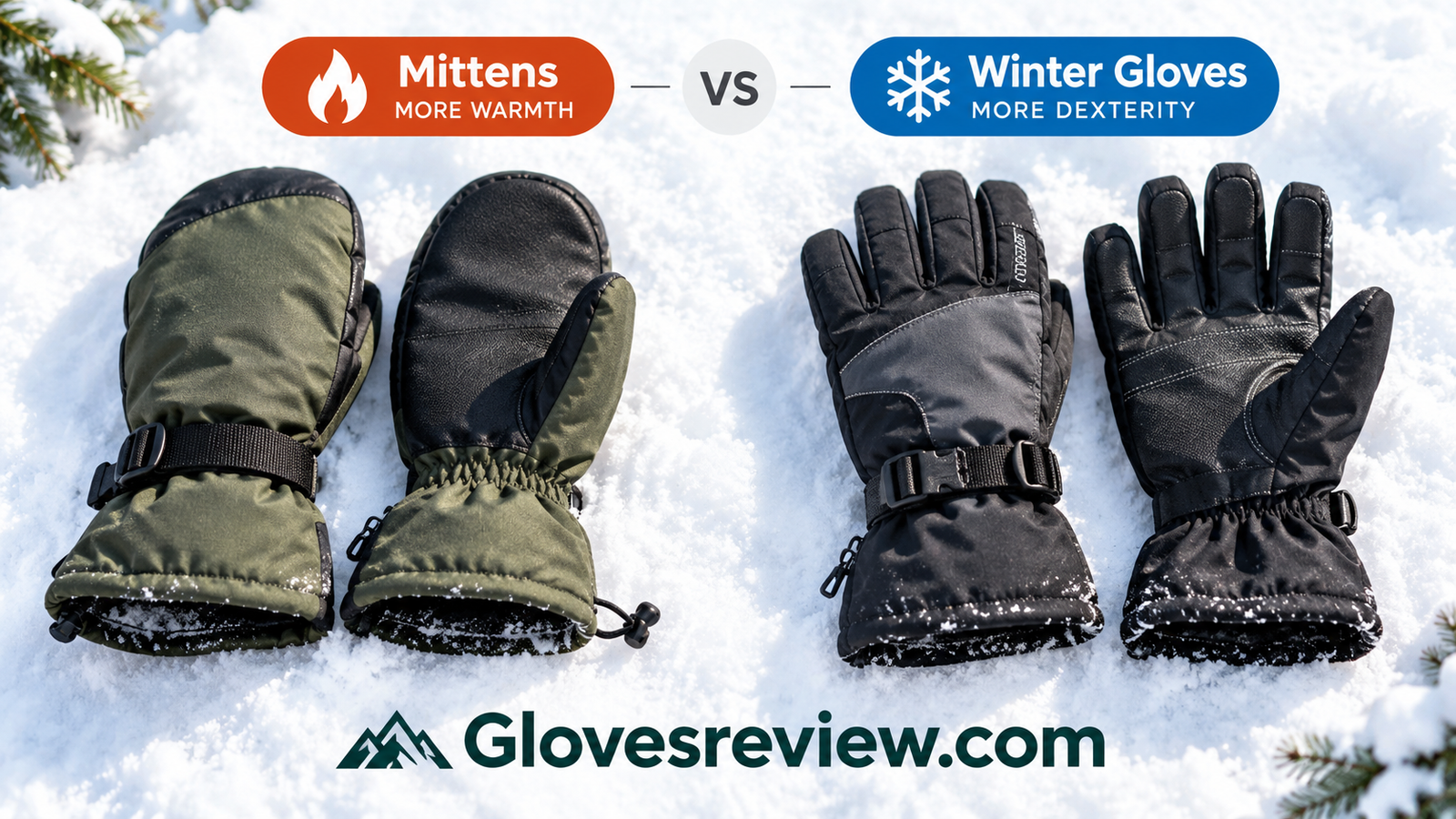
Mittens vs Gloves for Warmth: Which One Actually Keeps Your Hands Warmer?
One traps heat like a sleeping bag. The other lets you actually use your fingers. Here is the honest science, the trade-offs, and how to pick the right one for your winter.
The Argument That Only Happens in Cold Parking Lots
There is a specific kind of winter argument that plays out in driveways, chairlift lines and school drop-off loops every time the temperature really drops. One person pulls on a pair of fat, soft mittens, shoves their hands deep in their pockets and looks perfectly content. The other is wearing sleek gloves, juggling a phone, a coffee and a set of car keys, and is already complaining that their fingertips went numb ten minutes ago.
Neither of them is wrong. They are just optimising for different things. The mittens person chose raw warmth. The gloves person chose control. And that is the entire mittens versus gloves debate compressed into a single moment: warmth and dexterity pull in opposite directions, and every design decision in handwear is a negotiation between the two.
What makes the question harder than it looks is that the shape of the handwear is only one variable. Insulation type and loft, shell fabric, waterproofing, cuff design, fit, whether your hands are moving or standing still, whether you are working up a sweat, whether the wind is cutting sideways across a frozen lake — all of these change the answer. A cheap, loose, soaked-through mitten will lose to a well-made insulated glove every single time. The shape gives you a head start, not a guarantee.
This guide breaks the question down properly. We start with the physiology of why hands get cold in the first place, then compare mittens and gloves across every dimension that actually matters: warmth, dexterity, wet-weather performance, wind, layering, safety and cost over time. By the end you will know exactly which one belongs in your kit — and, more importantly, when the honest answer is “both”.
The Short Answer
Mittens are warmer than gloves in almost every cold scenario. Fingers sharing one chamber exchange heat with each other instead of losing it individually, and the reduced surface area means less heat escapes into the air. Gloves are cooler but dramatically more functional. For static cold — spectating, waiting, ice fishing, standing at a bus stop — choose mittens. For anything that needs finger control — driving, tools, zips, touchscreens — choose gloves. For genuinely harsh conditions where you need both, a lobster or split-finger design is the sensible compromise, and a thin liner glove worn underneath either option improves both warmth and practicality.
- Why the shape of your handwear matters more than the brand name on it
- A side-by-side warmth scorecard covering eight real-world factors
- Where each design wins, loses, and becomes genuinely dangerous
- Insulation, membranes and layering explained without the marketing fog
- A simple activity-based decision guide so you buy once and buy right
Start With the Right Category
Browse today’s most popular winter mittens and see what’s available.
Check Price on AmazonQuick Comparison: Our Top Picks
Before we dig into the science, here is the at-a-glance version. Rather than ranking a single product, this table compares the five handwear formats that show up in the warmth debate, what each one is genuinely best for, and where each one falls short. Use it to narrow the field, then read the matching deep-dive below.
Swipe to see more →
| # | Image | Type & Best For | Key Characteristics | Verdict | Where to Buy |
|---|---|---|---|---|---|
| 1 |

|
Top Pick Insulated Mitten Best for Raw Warmth | Shared heat chamber · Minimal surface area · Room for liners · Usually a longer gauntlet cuff | The warmth winner for static cold and deep freeze days. Accept the loss of fingertip control and nothing else beats it. | Check Price on Amazon |
| 2 |

|
Lobster / Split-Finger Mitten Best Compromise | Index finger isolated · Remaining fingers share a chamber · Good pole and tool grip | Keeps most of the mitten’s warmth while freeing one finger for triggers, zips and buckles. Skiing’s favourite middle ground. | Check Price on Amazon |
| 3 |

|
Three-Finger Mitten Best for Fine Tasks | Thumb and index separate · Two fingers grouped · Popular with photographers and hunters | More control than a mitten, more warmth than a glove. The split means slightly more exposed fabric and a little more heat loss. | Check Price on Amazon |
| 4 |

|
Insulated Glove Best for Dexterity | Individual finger chambers · Full grip and pinch control · Wide insulation range | Unbeatable when your hands have to work. Choose a roomier, heavily insulated model to close the warmth gap with mittens. | Check Price on Amazon |
| 5 |

|
Convertible Mitten Best for Mixed Days | Mitten shell over a glove or liner · Magnetic or velcro fold-back · Two-in-one versatility | Flip open for thirty seconds of dexterity, close up for warmth. Convenient, though the extra fabric and seams add bulk. | Check Price on Amazon |
Comparison reflects general category characteristics of each handwear format. Individual models vary significantly by insulation, shell and fit — the deep-dive sections below explain how to read those differences.
Why Your Hands Get Cold Before Anything Else
You can be dressed perfectly everywhere else and still end up with fingers that feel like they belong to someone else. That is not a failure of willpower or a sign that you bought the wrong jacket. It is how human thermoregulation is designed to work.
Your body’s first priority is protecting your core — the brain, heart and organs that keep you alive. When skin temperature starts to fall, the blood vessels in your hands and feet constrict sharply, shunting warm blood back toward the middle. Your extremities are treated as expendable. It is an efficient survival strategy and an extremely annoying one if you happen to need your fingers.
Hands are also simply bad at holding heat. Fingers have a high surface-area-to-volume ratio, meaning there is a lot of exposed skin relative to the amount of warm tissue inside. Each finger is essentially a thin, long radiator with three exposed sides. Multiply that by ten and you have a surprisingly large heat-loss surface attached to your body — one that is usually out in the open, gripping cold objects, and exposed to moving air.
The Four Ways Heat Escapes From Your Hands
- Convection. Moving air strips away the thin layer of warm air your skin has just heated. Wind turns a tolerable day into a painful one, and it is the reason a windproof shell matters more than a thicker lining in exposed places.
- Conduction. Direct contact with a cold object drains heat fast. Ski poles, steering wheels, handlebars, handrails, metal tools and dog leads all pull warmth straight out of your grip. Thicker insulation between skin and object helps enormously.
- Evaporation. Moisture is the silent killer. Damp insulation loses much of its ability to trap still air, and wet skin loses heat far faster than dry skin. Sweat from the inside and melting snow from the outside are both working against you.
- Radiation. Your skin simply radiates heat outward. Loft and dead air slow this down, which is why fluffy insulation beats thin fabric even when both feel equally soft.
Layer those four together and you can see why “just buy warmer gloves” is such poor advice. A heavily insulated glove with a soaked lining and a loose cuff is colder than a moderate mitten with a snug wrist seal, because the failure happens at the moisture and airflow level, not the thickness level.
Individual Variation Is Bigger Than People Admit
Two people standing on the same frozen sideline will not feel the same thing. Circulation quality, fitness, hydration, how much you have eaten, whether you smoke or drink alcohol, how cold-adapted you are, and simple genetics all change how your hands respond. People with Raynaud’s phenomenon — where fingers blanch white or go blue in response to cold or stress — face a much steeper problem and usually need to be more aggressive with insulation, wind protection and hand warmers than everyone around them.
Cold adaptation also plays a role. Someone who spends all winter outdoors generally handles the same temperature better than someone stepping out of a heated office twice a week. That does not mean you should tough it out; it means you should be honest about your own baseline rather than copying what an ice fisherman wears.
Takeaway: any handwear has three jobs — trap still air, block wind and water, and do both without squeezing the circulation that keeps your fingers alive. The mittens-versus-gloves question is really asking which shape does those jobs best.
If you are dealing with genuinely brutal conditions rather than an ordinary cold day, we go much deeper into layering, hand warmers and rewarming strategy in our guide to how to keep hands warm in extreme cold.
Beat the Cold at the Source
Shop windproof and insulated handwear built for deep winter.
Check Price on AmazonOne Chamber or Five: The Single Design Choice Behind the Whole Debate
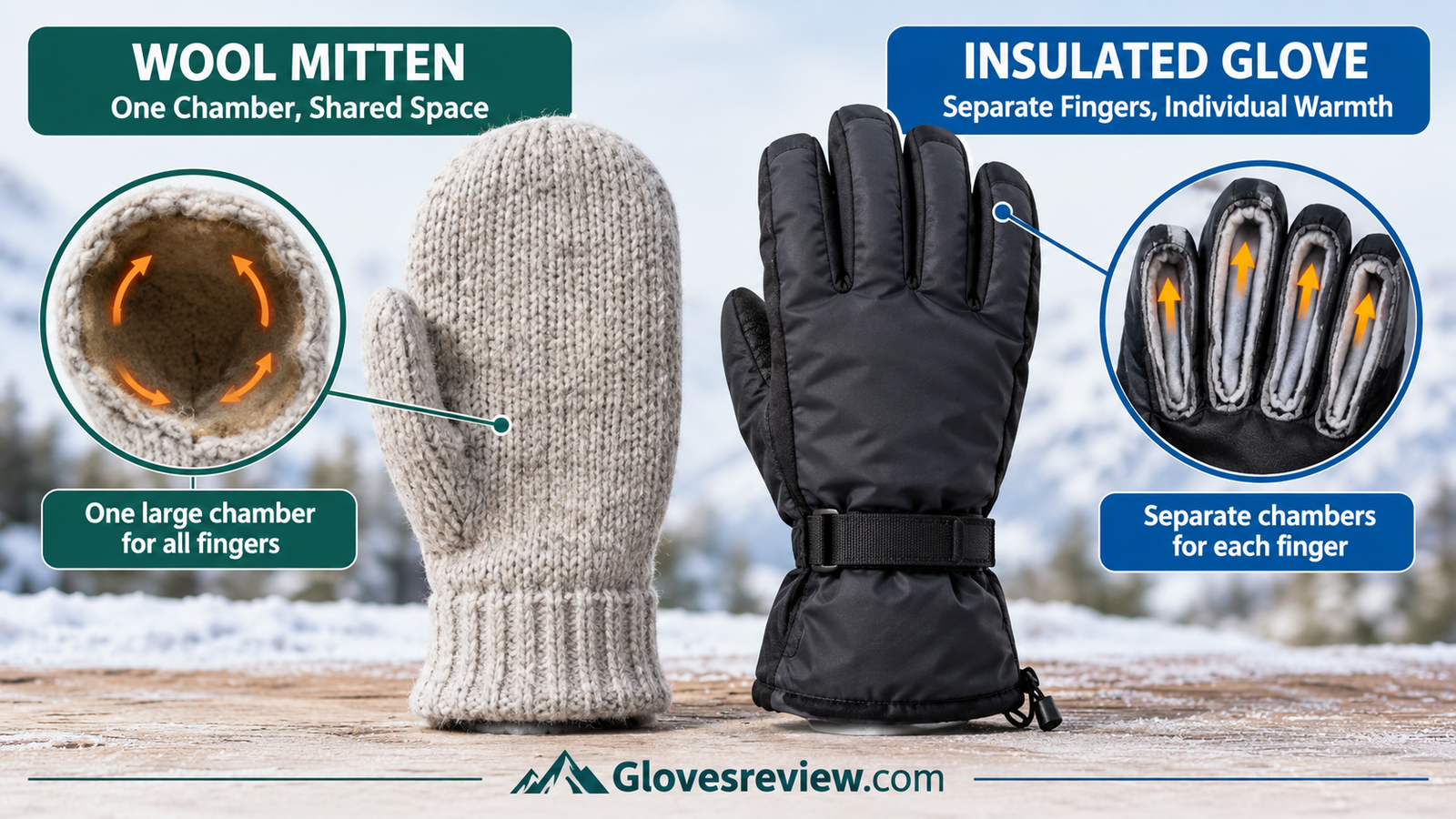
Strip away the branding, the marketing language about proprietary membranes and the colour options, and the difference between a mitten and a glove comes down to one thing: how many separate compartments your fingers live in.
In a mitten, four fingers share one pocket of air. In a glove, each finger gets its own tube of fabric, insulation and lining. That sounds like a small distinction. Thermally, it is the whole ball game.
Why Sharing a Chamber Works
Three things happen at once inside a mitten. First, the total surface area of fabric exposed to the cold is smaller, so there is simply less place for heat to escape. Second, your fingers warm each other. Fingers that are individually wrapped are each generating a tiny amount of metabolic heat and losing it on their own; fingers in a shared chamber pool that heat into one common reservoir. Third, the volume of still air inside the chamber is larger relative to its surface, and still air is what insulation actually is.
It is the same principle behind a sleeping bag versus five separate finger-shaped sleeping bags. Nobody would sleep warmer in the second option, even if it were made from identical material.
Where the Shape Stops Being the Answer
Shape is a head start, not a verdict. A thin fashion mitten made from a single layer of acrylic will lose to a properly insulated, windproof, well-fitted glove all day long. The order of operations matters: fit and circulation first, then moisture control, then insulation quality, and only then the shape of the shell.
Plenty of people also lose the mitten advantage by making simple mistakes. A mitten that is too tight crushes the loft that does the insulating and squeezes the blood supply. A mitten with a gap at the wrist turns into a bellows that pumps cold air in with every movement. A mitten worn over a damp liner is a damp mitten. Each of those undoes more warmth than the shape ever bought you.
The same logic applies at work. If your hands are swinging a shovel rather than holding still, the amount of heat you generate changes the equation completely — something we cover in detail in how to keep hands warm while working outside.
See What a Shared Chamber Can Do
Explore heavily insulated mittens built for extreme cold.
Check Price on AmazonWarmth Scorecard: How Mittens and Gloves Compare Across Eight Factors
Warmth is not one number. It is the outcome of several competing factors, and the two designs trade wins across them. Below is the full scorecard, followed by a visual summary so you can see the shape of the comparison at a glance.
Swipe to see more →
| Factor | Mittens | Gloves | Edge |
|---|---|---|---|
| Raw warmth in still air | Shared chamber, pooled heat, smaller surface area | Separate chambers, more exposed fabric | Mittens |
| Wind resistance | Fewer seams and panels for wind to exploit | More seams between fingers, more potential entry points | Mittens |
| Dexterity | Awkward for keys, zips, buckles, phones | Full grip, pinch and trigger control | Gloves |
| Wet snow handling | Large shell panels can soak through on the palm | Similar risk; more seams let water in sooner | Roughly even |
| Drying speed | Thick insulation holds moisture longer | Thinner chambers dry noticeably faster | Gloves |
| Layering flexibility | Roomy chamber accepts a liner easily | Tighter finger tubes can restrict liners | Mittens |
| Touchscreen use | Requires removal or a flip-back tip | Conductive fingertips work normally | Gloves |
| Long-term durability | Fewer seams and stress points to fail | Fingertips and knuckles wear first | Mittens |
Relative Performance at a Glance
These bars reflect how the two formats typically compare in real-world use, not laboratory measurements. Your specific pair may differ.
Reading the Scorecard Honestly
Mittens take four of the eight rows, and the rows they take are the ones that decide whether your hands feel warm. Gloves take the rows that decide whether your hands feel useful. That is why this debate never ends: people are scoring different columns.
One row deserves extra attention — wet performance. Shape matters less here than the shell and membrane, and the difference between “waterproof” and “water-resistant” is bigger than most shoppers realise. We unpack that distinction properly in our comparison of waterproof vs water-resistant gloves.
Find Your Balance
Compare insulated mittens and gloves built for real winter use.
Check Price on AmazonThe Case for Mittens: Where They Win and Where They Annoy You
If the only thing you care about is keeping your hands warm, the argument is settled before it starts. Mittens win. They win in dry cold, they win in wind, they win when you are standing still, and they win by a margin you can feel within minutes rather than hours.
That advantage shows up most clearly in exactly the situations people underestimate. Watching a football match from metal bleachers. Waiting for a bus in January. Holding a dog lead for an hour. Sitting on a chairlift. Ice fishing. Standing at a roadside on a cold morning. In all of these, your hands are generating very little heat of their own, and the mitten’s shared chamber is the difference between comfortable and miserable.
What Mittens Do Best
- Pool metabolic heat from all four fingers into one warm chamber
- Reduce exposed fabric and seams, which helps with wind and water entry
- Leave room for a liner glove or a chemical heat pack without compressing insulation
- Deliver outstanding value — cheap mittens often outperform cheap gloves
- Resist wear better, since there are fewer fingertips and knuckles to rub through
Pros
- Noticeably warmer in static, windy and deep-cold conditions
- Simple construction with fewer failure points
- Easy to layer over or under liners
- Excellent for children and anyone with poor circulation
- Usually lighter for the amount of warmth provided
Cons
- Poor control for keys, buckles, zips and phones
- Awkward for tools, poles and anything requiring a precise grip
- Thick insulation takes longer to dry once soaked
- Bulkier in a pocket or bag
- Easy to lose one, and a single lost mitten ends the day
The Practical Compromises That Make Mittens Livable
Most mitten frustrations are solved with small features rather than by switching to gloves. A wrist cinch or elasticated cuff stops warm air pumping out. A leash or attachment clip means you can strip a mitten off to use your fingers without dropping it in the snow. A short or long gauntlet decides whether snow gets into your sleeve. And a model with a flip-back fingertip gives you thirty seconds of dexterity without giving up the chamber.
For skiers and riders, the choice between a mitten and a glove is one of the most common gear decisions on the mountain, and the specifics of insulation, palm material and cuff style matter a great deal — see our full guide to the best ski gloves for how the two formats compare in resort and backcountry use.
Who Should Buy Mittens First
Spectators, dog walkers, parents on the school run, commuters standing at stops, ice anglers, snowshoers, anyone with cold-sensitive circulation, and anyone whose hands are mostly in their pockets anyway.
Get the Warmest Hands on the Block
Shop highly rated winter mittens in every price range.
Check Price on AmazonThe Case for Gloves: When Being Able to Use Your Hands Wins
Ask anyone who works outdoors in winter whether they would rather be warm or be able to do their job, and you will get the same answer. Gloves are not the warmer option, but they are the functional one, and functionality is not a luxury when your hands are earning your living.
Consider what a normal cold day actually demands of your fingers. Zipping a coat. Working a car door handle and seatbelt. Digging out keys. Typing a passcode. Holding a cup. Opening a stubborn wrapper. Loosening a bolt. Gripping a pole with enough precision that you do not lose control of it. Every one of those becomes a clumsy, frustrating performance in mittens, and each one forces you to expose bare skin to the cold for a few seconds at a time.
Those seconds add up. Taking mittens off repeatedly can make your hands colder overall than wearing slightly cooler gloves continuously, because you keep breaking the thermal seal and dumping heat.
What Gloves Do Best
- Preserve grip precision for tools, poles, buckles and steering wheels
- Allow touchscreen use without removing anything
- Make small, fiddly tasks quick instead of a chore
- Fit closer to the hand, which improves feel and reduces snagging
- Dry faster thanks to thinner individual finger chambers
Pros
- Full finger control for work, driving and sport
- Touchscreen-friendly options widely available
- Lighter and less bulky to carry
- Faster drying after sweat or snow
- Wider variety of technical constructions
Cons
- Colder at the fingertips in wind and deep freeze
- More seams for wind and water to exploit
- Fit is critical — a tight glove is a cold glove
- Fingertips wear through faster than mitten panels
- Less room for liners and hand warmers
Closing the Warmth Gap
If you have to wear gloves but still need serious warmth, the strategy is straightforward. Choose a model with a gauntlet cuff that seals over your sleeve. Prioritise a windproof shell. Size up enough to keep a thin liner underneath without compression. Look for insulation in the back of the hand as well as the palm, since the back loses heat faster. And keep a spare pair, because a wet glove is a cold glove no matter how good it was this morning.
For anyone whose winter is mostly about work rather than leisure — shovelling, clearing drives, handling materials and tools — the fit and durability requirements are different from casual wear. Our roundup of the best winter work gloves covers the constructions that survive real use.
Keep Your Fingers Working
Shop insulated gloves with the grip and control you need.
Check Price on AmazonLobster Mitts, Three-Finger Designs and Convertibles: Splitting the Difference
Once you accept that mittens win on warmth and gloves win on control, the obvious question is whether you can have most of both. The outdoor industry has been answering that question for decades, and the answers are genuinely useful — with real trade-offs of their own.
Swipe to see more →
| Design | How It Splits the Hand | Warmth vs a Mitten | Dexterity vs a Glove | Best Suited To |
|---|---|---|---|---|
| Lobster / split-finger | Index finger alone; middle, ring and pinky share a chamber | Very close | Moderate | Skiing, cycling, pole sports, trigger use |
| Three-finger mitten | Thumb and index separate; two fingers grouped | Slightly lower | Good | Photography, hunting, fishing, field work |
| Convertible mitten | Full mitten shell over a glove or liner, fold-back cover | Equal when closed | Full, briefly | Variable days, travel, commuting |
| Mitten with flip tip | Mitten with a magnetic fingertip that opens | Nearly equal | Limited but handy | Phones, tickets, dog leads |
| Over-mitt / shell mitt | Loose waterproof mitt worn over any glove | Adds wind and water protection | Retained underneath | Wet snow, storms, layering systems |
Why the Compromises Work
The lobster design is the most successful of these for a simple anatomical reason: the index finger is the one that does most of the precision work. Freeing it gives you trigger control, zip pulls, pole straps and screen taps while the remaining three fingers stay bundled in a shared warm pocket. You give up a little surface-area advantage, but far less than a full glove demands.
Three-finger designs take that logic further and are beloved by photographers and hunters who need a shutter finger and a thumb. The cost is that you now have two separate chambers rather than one, so the warmth advantage erodes a little more.
Convertibles are about convenience rather than physics. A mitten shell over a glove lets you move between full dexterity and full warmth in seconds, which is ideal on days that swing between active and static. The downside is bulk, weight and one more thing to flap around. A separate waterproof over-mitt achieves something similar with better layering logic and less fuss.
The Honest Assessment
None of these are as warm as a straight mitten and none are as nimble as a straight glove. They occupy the middle, and for a lot of real winter days the middle is exactly where you want to be. If you ski, cycle or spend long stretches outdoors alternating between fine tasks and stillness, a lobster or convertible design is very likely the right answer rather than a compromise you settle for.
Quick rule: if you take your handwear off more than a few times an hour, a split or convertible design will keep you warmer in practice than a mitten you keep removing.
Insulation, Shells and Linings: The Stuff That Actually Does the Work
Shape sets the ceiling. Materials decide how close you get to it. Two pairs that look almost identical in the shop can perform completely differently once the wind picks up, and the difference lives in the layers you cannot see.
Insulation Types, Explained Without the Hype
Swipe to see more →
| Insulation | Strengths | Weaknesses | Feels Like |
|---|---|---|---|
| Synthetic microfibre | Warm when damp, quick to dry, consistent performance, widely available | Can pack down over seasons of hard use | The default for most technical winter handwear |
| Down | Outstanding warmth-to-weight, very compressible, luxurious feel | Loses loft badly when wet; slower to dry; usually pricier | Light, lofty, superb in dry cold |
| Fleece | Breathable, soft, dries quickly, great as a liner | Weak wind resistance on its own, limited loft | Warm and airy in calm conditions |
| Wool / merino | Retains warmth when damp, naturally odour-resistant, excellent next to skin | Dries slowly, can feel clammy when saturated, needs a shell | Comfortable, dry-warm rather than hot |
| Lofted pile / shearling | Very warm, durable, comfortable for long static periods | Bulky, heavy, slow drying | Deep, enveloping warmth |
Shell, Lining and the Boring Details That Matter
The shell is your weather barrier. Soft, stretchy woven shells feel great and breathe well but let wind through. Coated or laminated shells with a windproof and waterproof membrane cut wind completely and keep melting snow out, at some cost in breathability. For wet, windy climates the membrane matters more than extra insulation.
The lining is your moisture manager. A brushed or fleece lining feels instantly warm and helps wick sweat away from skin. A smooth lining makes it easier to slide your hand in and out, which matters more than people expect when your hands are cold and stiff.
Palm material controls grip and conduction. Leather palms grip better and last longer, but they also conduct cold from poles and tools more readily, and they need occasional conditioning. Synthetic palms with textured grip patterns are lighter and cheaper, and modern versions are genuinely good.
If you are weighing synthetic microfibre against fleece for your next pair, we compare the two directly in Thinsulate vs fleece gloves.
Choose the Right Insulation
Shop synthetic, down and wool-lined winter handwear.
Check Price on AmazonWaterproofing and Moisture: The Warmth Killer Nobody Talks About
Here is the uncomfortable truth about handwear: most cold hands are wet hands. Not soaking wet, not obviously wet — just damp enough that the insulation has lost its loft and the fabric is pulling heat away from the skin. People then blame the insulation weight, or the shape, or their own circulation, when the real culprit is moisture management.
Moisture attacks from two directions. From outside: snow that lands on the cuff and melts, rain that soaks the shell, the wet dog lead, the slushy car door handle. From inside: sweat. Your hands perspire surprisingly hard during activity, and in cold air that vapour condenses inside the insulation where it is very hard to remove.
Waterproof, Water-Resistant and Breathable Are Not the Same Thing
- Water-resistant shells shed light snow and brief contact with moisture, then eventually wet out. They breathe better and cost less.
- Waterproof constructions use a membrane or coating that blocks liquid water. They perform far better in sustained wet snow and slush.
- Breathable refers to how well water vapour escapes from the inside. Waterproof and breathable pull against each other, which is why no handwear is perfect at both.
- Sealed seams and gauntlet cuffs often matter more than the headline membrane, because water enters at the openings first.
Choosing between them is mostly a climate question. Dry, bitter continental cold rewards insulation and breathability. Wet coastal winter snow rewards waterproofing first and insulation second. If you are unsure which you actually need, our guide to waterproof vs water-resistant gloves lays out the difference in practical terms.
Sweat Management: The Inside Job
Overdressing your hands is the classic mistake. You start a walk or a shovel session warm, your hands work hard, sweat builds, and twenty minutes later the insulation is damp and you are colder than if you had worn less. The fix is a removable liner system. Start with the liner only, add the shell when you stop or when the wind rises, and pull the liner out of the shell at rest breaks to let vapour escape.
Breathable shells help, but nothing beats ventilation and the ability to shed a layer. Oversized mittens with a liner are more forgiving here than snug gloves, because there is simply more air volume to buffer the moisture.
Drying Is a Skill, Not an Afterthought
Wet handwear dried badly is handwear that is worse next season. Direct heat — radiators, hairdryers, heated car vents, campfires — damages membranes, shrinks leather and melts synthetic fibres. Gentle warmth, good airflow and patience are the answer, and turning gloves or mittens inside out halfway through makes a huge difference to how evenly they dry.
We cover the full process, including what to do the night before you need them again, in our guide on how to dry wet gloves. And if your shells have stopped beading water the way they used to, restoring the durable water repellent finish is usually simpler than replacing the pair — see how to waterproof gloves.
Fit, Sizing and Layering: The Multiplier Effect
Insulation does not create warmth. It slows the loss of warmth your body already has. That is why fit is not a cosmetic concern — it is the mechanism by which insulation works at all. Compress the loft and you compress the trapped air, and the pair you paid good money for performs like a cheap one.
The Two Failure Modes of Fit
Too tight. The obvious one. Insulation gets squashed, the skin has less warm air around it, and — much worse — the glove squeezes the blood vessels that supply your fingers. A tight glove is colder than a loose one at the same insulation level, every time. If your fingertips feel tingly or pale within minutes, size is the first suspect.
Too loose. Less obvious, but real. A sloppy fit lets cold air circulate inside the chamber and reduces the contact that keeps warmth where you want it. You also lose grip precision, which makes you squeeze harder and again restrict circulation. The ideal fit is snug at the palm and wrist, with just enough room at the fingertips for a thin liner and a little air.
- Measure your hand properly rather than guessing from shirt size
- Check the fit with the liner you actually intend to wear
- Prioritise a secure wrist closure — that seal decides how much warm air stays in
- Make sure you can still make a fist without the cuff riding up
- Test fingertip room by pressing your thumb to each fingertip in turn
Hand measurement is quick and removes most of the guesswork from online ordering; the method is laid out step by step in how to measure hand size for gloves. If you have already got a pair and you are trying to work out whether the fit is the problem, how should winter gloves fit walks through the checkpoints.
The Liner System
A thin liner underneath your main handwear is the single cheapest upgrade in this entire category. It adds a little insulation, it manages moisture at the skin, and it means you can take your outer layer off for a task without exposing bare skin to the air. On warmer stretches you can wear the liner alone.
Merino and synthetic liners both work well. Merino feels warmer when damp and resists odour over long trips. Synthetic liners dry faster and are usually thinner for the same feel. Either way, the liner must fit loosely enough not to restrict circulation but closely enough to make contact with the skin — otherwise it is just another layer of dead space.
Do liners actually make a measurable difference? We tested the logic in detail in do glove liners work.
Layering Cheat Sheet
Mild and active: liner alone.
Cold and active: liner plus shell glove.
Cold and static: liner plus insulated mitten.
Wet and windy: liner plus insulated glove plus waterproof over-mitt.
Choosing by Activity: What You Are Doing Decides What You Wear
Ask “which is warmer, mittens or gloves?” and the real answer is always “warmer for what?”. Your hands are a small engine. When they are working hard they generate plenty of heat and the priority shifts to breathability and dexterity. When they are idle, the priority is pure heat retention. The same person needs opposite equipment on the same afternoon.
Swipe to see more →
| Activity | Hands Are… | Best Format | Why |
|---|---|---|---|
| Snow shovelling | Very active, gripping cold tools | Insulated glove or lobster | You need grip and dexterity, and you generate plenty of heat |
| Winter work outdoors | Active, handling materials | Durable insulated glove | Control and abrasion resistance matter more than peak warmth |
| Resort skiing | Mixed: active runs, cold lifts | Mitten or lobster | Lift time is static; shared warmth wins on the way up |
| Ski touring | Very active on climbs | Light glove plus shell | Breathability and venting prevent sweat soaking |
| Spectating / school runs | Idle | Insulated mitten | Maximum heat retention with zero need for dexterity |
| Driving | Active, precise grip | Snug glove | Steering and control require finger separation |
| Running / cycling | Very active | Windproof light glove | Overheating and sweat are the bigger enemies |
| Photography / hunting | Mixed | Three-finger mitten or flip-tip | Shutter and trigger finger need to be free |
Static Cold Versus Active Cold
This is the most useful distinction in the whole category. Static cold means standing, sitting or waiting. Your hands are producing almost no heat of their own, wind chill is doing all the work against you, and insulation is the only defence. Mittens dominate here by a wide margin, and adding a chemical heat pack inside the chamber makes a dramatic difference.
Active cold means working, moving, climbing or shovelling. Your hands are generating real heat, sweat becomes a genuine risk, and breathability plus grip matter more than peak insulation. Gloves dominate here. Wearing heavy mittens during hard work is a classic mistake: your hands overheat, sweat, and then chill the moment you stop.
Shovelling, Work and Tool Handling
Clearing snow is one of the most common winter tasks and one of the worst for handwear. You are gripping a cold handle, generating heat in bursts, then standing still to catch your breath. A waterproof, insulated glove with a grippy palm beats a mitten for control, but bring a spare pair so you can swap out the damp one halfway through. If you want a ready-made shortlist, our guide to the best gloves for snow shoveling covers exactly this scenario.
On the Mountain
Skiing and riding push both priorities to the extreme: you need to grip poles and buckles, but you also spend long stretches sitting on a cold lift with no hand movement. Most experienced skiers end up owning both a mitten and a glove, or a lobster design that splits the difference. Fit, cuff length, palm material and how the pair works with your jacket sleeve all matter — covered in detail in how to choose ski gloves.
Match the Gear to the Day
Shop activity-specific winter handwear for work, sport and play.
Check Price on AmazonWhen Cold Stops Being Uncomfortable: Frostbite, Circulation and Knowing When to Stop
Most of this guide is about comfort. This section is about the point where comfort stops being the right frame. Fingers are among the most frostbite-prone parts of the body precisely because of everything we discussed earlier: thin, exposed, high surface area, and first in line for reduced blood flow when your core gets cold.
The Warning Stages
- Cold and clumsy. Numbness, stiffness, difficulty with fine tasks. Your hands are telling you to warm up now, not later.
- Frostnip. Skin feels very cold, may look pale or reddened, and is uncomfortable rather than dangerous. Fully reversible with prompt warming.
- Frostbite. Skin turns white, waxy or greyish and feels hard or numb. This is a medical injury. Numbness is deceptive — the absence of pain is a symptom, not an improvement.
What To Do
Get out of the wind and cold. Remove wet handwear and any tight rings or cuffs. Rewarm gradually in body heat — armpits, a warm torso — or in comfortably warm water, and expect pain and colour to return as circulation resumes. Do not rub the area, do not use direct radiant heat such as a heater, fire or hot exhaust, and do not rewarm tissue if it could refreeze before you reach shelter. If skin stays white, hard or blistered, seek medical attention.
This is general safety guidance, not medical advice. In any serious case, contact a healthcare professional.
Prevention Beats Treatment Every Time
- Keep your core warm — a cold torso means cold hands, regardless of your handwear
- Keep moving to drive blood out to the fingers
- Eat and hydrate; your body needs fuel to generate heat
- Carry chemical heat packs for emergencies and long static periods
- Change out of damp liners before they chill you
- Take numbness seriously instead of waiting it out
Heated Handwear
Battery-powered heated gloves and mittens exist precisely for the situations where insulation alone is not enough: Raynaud’s, very long static periods, extreme cold work, and poor circulation. They are not magic, and battery life, charging logistics and durability all deserve scrutiny before you spend, but for a specific group of users they are transformative rather than gimmicky. If you are considering them, our guide to the best heated gloves covers what actually matters in a heated pair.
Add a Backup Heat Source
Shop reusable and disposable hand warmers for emergencies.
Check Price on AmazonCare, Drying and Re-Proofing: Making Your Handwear Last More Than One Season
Good winter handwear is one of those purchases where a little maintenance pays for itself many times over. The construction is usually sound; what fails is the waterproofing, the cuff elastic, the lining’s ability to wick, and the leather on the palm. All of those respond well to basic care.
What Actually Wears Out
- The water repellent finish. Shells stop beading water long before they are physically worn out. This is maintenance, not failure.
- Insulation loft. Repeated soaking and aggressive heat flattens insulation permanently. Dry gently and store uncompressed.
- Palm material. Leather dries out and cracks; synthetics abrade at the fingertips and thumb crotch.
- Cuffs and closures. Elastic and velcro lose grip, which lets cold air in regardless of everything else.
The Care Routine That Works
- Empty pockets, close zips and velcro, and secure any removable leashes before washing
- Wash gently with a technical-safe detergent rather than ordinary powder or fabric softener
- Rinse thoroughly; residue left in the lining kills breathability and wicking
- Reshape while damp so the fingers and thumb dry in the right position
- Dry slowly with good airflow, away from direct heat, and turn mittens part-way through
- Refresh the water repellent finish when water stops beading on the shell
- Store uncompressed, clean and completely dry, away from damp garages and lofts
Washing is where most damage happens, largely because people treat handwear like ordinary laundry. The full method, including what to avoid with leather palms and membranes, is in our guide to how to wash winter gloves.
Repair or Replace?
Small failures are worth fixing. A lost cuff snap, a hole at a fingertip, a separated seam at the thumb — all of these can be repaired cheaply and extend a good pair by several seasons. Replace when insulation is permanently flattened, when membranes delaminate, or when the pair no longer keeps your hands warm in the conditions it was bought for. There is no prize for suffering through a pair that has simply reached the end.
Longevity rule: if you own only one pair, buy for the coldest day you realistically face and maintain it properly. If you own two, keep one dry pair as an emergency swap — that alone solves more cold-hand problems than any product upgrade.
Protect Your Investment
Shop technical detergents and re-proofing treatments for winter gear.
Check Price on AmazonFrequently Asked Questions About Mittens and Gloves
Are mittens always warmer than gloves?
In almost every realistic scenario, yes — but “always” is doing some work in that sentence. A well-made, windproof, well-fitted glove will beat a thin, loose, soaked mitten. The shape gives mittens a structural advantage; fit, insulation and moisture management decide whether that advantage is actually realised.
Why are mittens warmer than gloves?
Because your fingers share one chamber instead of living in four separate ones. Shared air means shared heat, the total surface area losing warmth is smaller, and there are fewer seams for wind to exploit. It is the same reason a sleeping bag beats five finger-shaped ones.
Are mittens better in wet snow than gloves?
Not automatically. Shape matters less than the shell and membrane in wet conditions. Mittens have fewer seams for water to enter through, which helps, but they also soak through in fewer places and dry more slowly. In genuinely wet snow, waterproof construction and a gauntlet cuff matter more than whether it is a mitten or a glove.
Are lobster mitts warmer than gloves?
Usually yes. By grouping three fingers together they keep most of the shared-heat benefit while freeing the index finger for triggers, poles and zip pulls. They are slightly cooler than a full mitten and slightly less nimble than a full glove, which is exactly why so many skiers and cyclists choose them.
Should I wear liners under mittens or gloves?
In most cases, yes. A thin liner adds a small amount of insulation, manages sweat against your skin, and lets you perform tasks without exposing bare hands. The one exception is a pair that already fits tightly — adding a liner to a snug glove compresses the insulation and makes your hands colder, not warmer.
How do I keep my fingers warm inside gloves?
Start with fit. Tingly or pale fingertips usually mean the glove is too tight or the cuff is too loose. Then manage moisture by wearing a wicking liner, seal the cuff over your sleeve, and keep moving to maintain circulation. Chemical heat packs placed against the back of the hand help more than people expect.
Are heated gloves warmer than mittens?
They can be, particularly in extreme cold or for people with poor circulation, because they add an active heat source rather than merely trapping what your body produces. The trade-offs are battery life, charging, cost and long-term durability. For genuinely static, brutal conditions they are a legitimate solution rather than a gimmick.
Do looser gloves keep your hands warmer?
Up to a point. A little extra room preserves loft and leaves space for a liner, which helps. Beyond that, a sloppy fit lets cold air move around inside the chamber and reduces the grip that keeps warmth in your hand. Aim for snug at the palm and wrist with a small amount of room at the fingertips.
When should I switch from gloves to mittens?
When your hands stop doing fine tasks and start doing nothing. Standing, waiting, spectating and riding lifts are mitten territory; driving, working and handling tools are glove territory. A good practical trigger is this: if you are taking your gloves off repeatedly to use your phone or keys, a mitten with a flip tip or a lobster design will serve you better.
Are mittens better for children?
For younger children, overwhelmingly yes. Kids have poorer circulation and a harder time managing layers, and mittens are easier to get onto small hands, harder to lose individual pieces from, and warmer for the same bulk. Add a leash that clips to the coat cuff and the classic “lost mitten” problem largely disappears.
Can I use mittens for skiing?
Absolutely — many skiers and riders prefer them. You lose some dexterity for buckles and zips, which is why a lobster design or a pair with a flip tip is a popular compromise. If you ski in very cold, dry conditions, mittens are usually the warmer choice on the lift.
How do I stop my hands sweating in mittens?
Wear less insulation than you think you need during activity, use a thin wicking liner you can remove, and open or vent during exertion. Sweat is the fastest route to cold hands later, so the goal is to stay slightly cool at the start rather than toasty. If your liners are damp after an hour, you are overdressed.
Mittens vs Gloves for Warmth: Which Should You Buy?
If you have read this far, the answer is probably clearer than it was when you started. Mittens win the warmth argument on physics alone: one chamber instead of five, less exposed fabric, pooled heat, fewer seams. Gloves win the usefulness argument just as decisively. Neither is the “right” answer in the abstract, because warmth and dexterity are traded against each other rather than measured on the same scale.
The Simple Decision Framework
- Buy mittens if your hands are mostly idle in cold weather — spectating, walking, waiting, commuting by foot, or anything where you can keep your hands in your pockets between tasks.
- Buy gloves if your hands are working — driving, tools, shovelling, poles, screens, straps, anything that needs fingertip control.
- Buy lobster or convertible designs if your days alternate between both, which describes most skiing, hiking and outdoor work.
- Buy a liner system regardless. It improves warmth, moisture control and practicality in every single scenario described above.
- Buy for the wind and the wet, not just the thermometer. A windproof, waterproof pair of moderate warmth beats an uninsulated-against-weather pair that looks thicker.
And if you can only afford one purchase, buy the pair that suits the coldest thing you actually do — then buy a cheap second pair as a dry emergency swap. That two-pair strategy solves more real cold-hand problems than any single premium product ever will.
Ready to Upgrade Your Winter Hands?
Compare today’s top-rated mittens and gloves and find your fit.
Check Price on AmazonYou May Also Like
Keep reading for deeper dives on insulation, heated gear, waterproofing and finding the right glove for the job.
Best Waterproof Winter Gloves
Pairs that keep melting snow out without turning your hands into a sauna.
RoundupBest Heated Gloves
When insulation alone is not enough: what to look for in battery-powered warmth.
RoundupBest Touchscreen Gloves
Winter handwear that still lets you answer a message without frostbite.
ExplainerHow Do Heated Gloves Work?
Heating elements, batteries and heat distribution explained in plain language.
Buyer’s GuideAre Heated Gloves Worth It?
Who genuinely benefits from active heating and who is better off with insulation.