
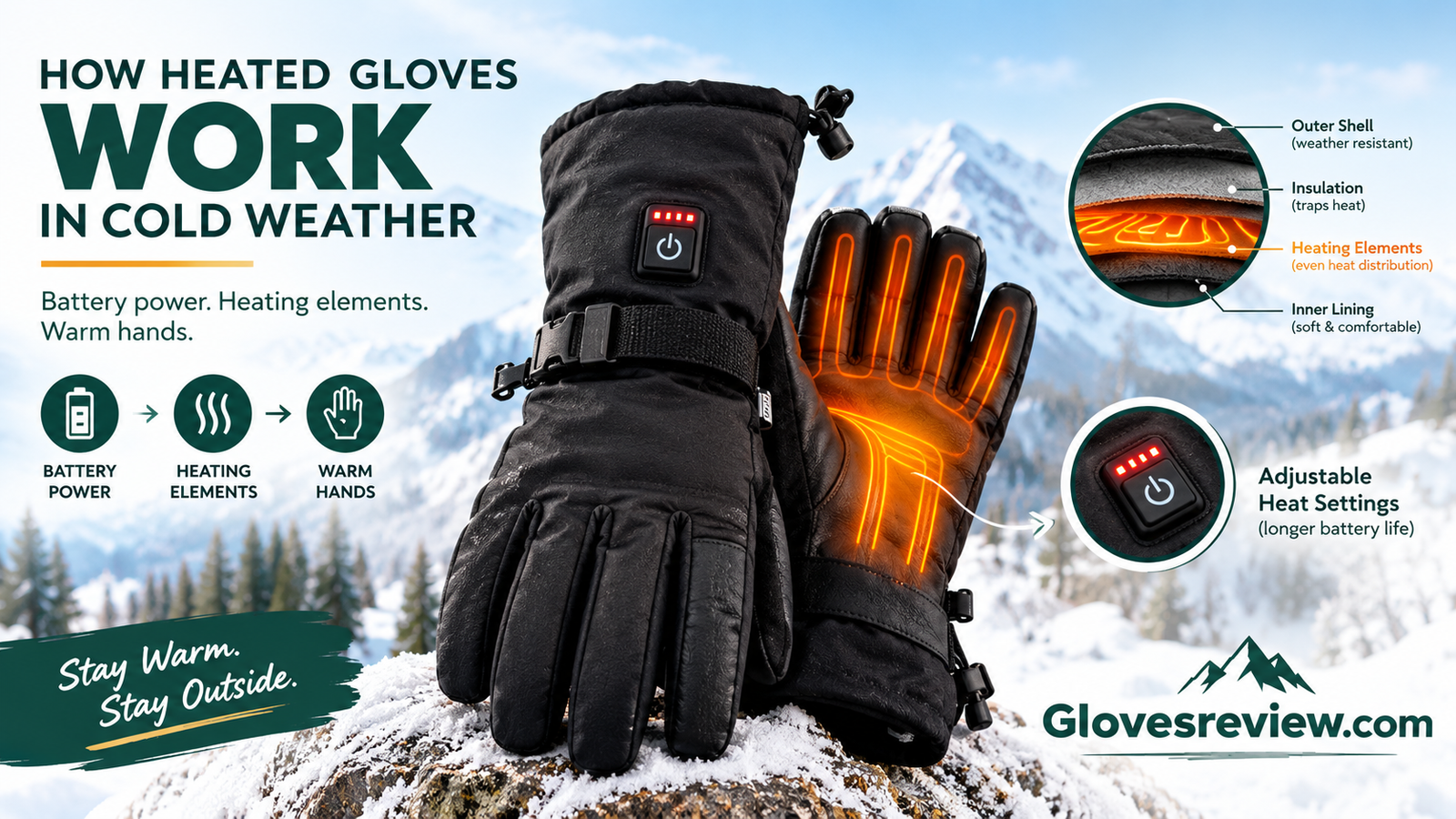
How Do Heated Gloves Work? The Batteries, Elements, and Layers Behind Warm Hands
Heated gloves look like ordinary winter gloves with a button on the back. What happens after you press that button is a surprisingly tidy chain of physics and engineering — and understanding it is the fastest way to buy a pair that actually keeps you warm.
What We Mean When We Ask “How Do Heated Gloves Work?”
There is a moment nearly everyone shares the first time they hold a pair of heated gloves: you turn one over in your hands, find the little battery tucked into a cuff pocket, and wonder how something that thin and flexible can push back against a freezing wind. The answer is not magic, and it is not a single clever invention. It is a system — a small electrical circuit, a resistive material that turns current into heat, and a stack of insulating layers designed to keep that heat from escaping.
Once you see the system clearly, a lot of confusing product language falls into place. Words like “carbon fiber heating elements,” “three heat settings,” “smart temperature control,” and “extended cuff” are all describing one of four jobs: generate heat, distribute heat, regulate heat, or retain heat. A glove that does all four well feels dramatically warmer than a glove that only does one or two — even if both claim identical features on a product page.
This guide walks through the whole chain in plain English. We will look at the physics of heat loss, tour a heated glove layer by layer, dig into the heating element and the battery that feeds it, and then translate all of that into practical decisions: what to buy, how to care for it, and how to get more warmth out of what you already own. Along the way we will compare heated gloves to mittens, liners, and chemical warmers, because “how do heated gloves work” is really the first half of a bigger question — “and do they work better than the alternatives?”
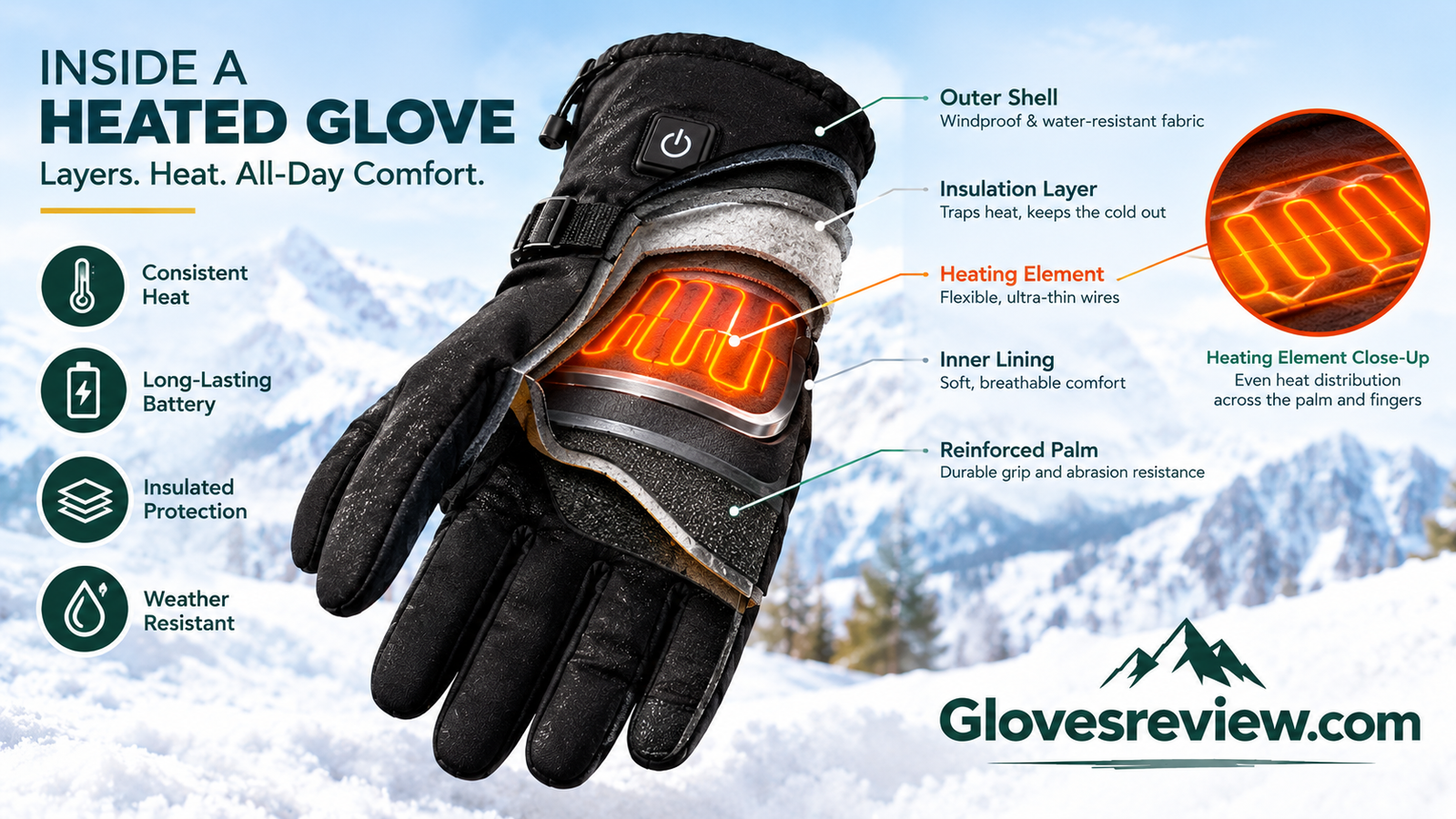
Sub hero image: a cutaway view of the layer stack — shell, membrane, insulation, heating element, and lining.
Quick orientation: Heated gloves are a supplement to insulation, not a replacement for it. The battery adds energy to the system; the insulation decides how far that energy goes. If you remember only one idea from this article, make it that one.
Takeaway: the button does not “make heat” — it tells a small controller how much current to send to the element. Everything else in the glove exists to keep the resulting warmth close to your skin.
Compare battery systems, heat zones, and insulation styles side by side.
The Short Answer: How Heated Gloves Actually Work
Strip a heated glove down to its essentials and you have four components: a rechargeable battery, a thin resistive element, a controller, and a pile of insulation wrapped around all of it. When you switch the glove on, the battery pushes electrical current through the heating element. That element is made from a material that resists the flow of electrons — carbon fiber is the most common choice, though alloy wires and printed heating films are used too. As electrons fight their way through that resistance, they collide with the material’s atomic structure, and those collisions release energy in the form of heat. Engineers call this resistive or Joule heating, and it is exactly the same process that warms a toaster filament, an incandescent bulb, or the seat heater in your car.
From there, the heat spreads. The element is usually laid out across the back of the hand and run down toward the fingers, then covered by a lining that touches your skin. Heat moves from the element into the lining by conduction, from the lining to the air inside the glove by convection, and then is slowed on its way out by the insulation and outer shell. Your hand is the final destination, and the whole design goal is to keep the temperature gradient working in your favor: warmer inside, colder outside, with a thick barrier in between.
The controller is the piece most people never think about. It sits between the battery and the element and acts like a dimmer switch, either stepping current up and down across fixed heat levels or cycling it automatically to hold a target temperature. Better systems add a temperature sensor near the element so the glove can back off when it gets hot enough and push harder when the cold wins. That feedback loop is the difference between “warm for twenty minutes and then too hot” and “comfortable for hours.”
One detail surprises people: most heated gloves concentrate their elements on the back of the hand and the tops of the fingers, not the palm. There are good reasons for this. The palm needs to stay flexible and grippy, it is the part of the glove that takes the most abrasion, and it is often pressed against cold metal — a handlebar, a ski pole, a ladder rung — which sucks heat away faster than any element can replace it. Meanwhile, the back of the hand has a large surface area and reasonably good blood flow, so warming it raises the temperature of the blood circulating into the fingers. Heat the reservoir, and the extremities benefit.
So when a product description says a glove has “heating elements across the back of the hand and fingers,” it is telling you something meaningful about the design strategy. When it says “full-finger heating,” that usually means the elements run further toward the fingertips — which helps, but only if the battery and insulation are up to the job.
Browse battery-powered gloves with back-of-hand and full-finger heat zones.
Why Your Hands Get Cold First: The Science Behind the Problem
To understand why heated gloves exist, it helps to understand why ordinary gloves so often fail. Your body treats its core temperature as non-negotiable. When the environment turns cold, blood vessels in your hands and feet constrict, narrowing the flow of warm blood to the extremities so that the heat stays where the vital organs are. Fingers are the first casualty of that decision. They are thin, they have a lot of surface area relative to their volume, and they are at the far end of the circulation pipeline. It is a perfectly sensible survival strategy and a terrible experience if you are trying to work, ride, or ski.
Three forces then attack whatever heat remains. Conduction pulls warmth away whenever your hand touches something colder — a tool handle, a railing, a zipper. Convection strips away the thin layer of warm air sitting against your skin, which is why a breeze makes the same temperature feel far worse. Evaporation is the quiet one: moisture from sweat or melted snow turns to vapor and takes a remarkable amount of heat with it. Add radiant loss to a clear night sky and you have a hand that is losing energy from every direction at once.
Insulation works by trapping still air — still air is a poor conductor, so a thick, lofty layer dramatically slows the escape of heat. But insulation has limits. Compress it (by gripping something tightly or wearing a glove that is too small) and it loses loft and therefore performance. Get it wet, and the trapped air is replaced by water, which conducts heat roughly two dozen times faster than air does. This is why a soaked glove feels cold almost instantly, and why moisture management matters as much as thickness.
Active heat changes the arithmetic. A passive glove can only slow the loss; a heated glove can actually add energy to the system, which matters enormously when your circulation has already downgraded your fingers. In genuinely severe conditions, that added energy is the difference between functional hands and painful ones. If you routinely deal with deep cold, our companion guide on how to keep hands warm in extreme cold covers the broader strategy — layering, core temperature, movement, and nutrition — that makes any glove work better.
Worth knowing: keeping your core warm helps your hands. When your torso is cold, your body constricts hand circulation even harder. A heated vest or a proper shell can improve hand warmth more than an extra layer on the hands themselves.
Start with gloves designed for real wind and low temperatures.
Anatomy of a Heated Glove: A Layer-by-Layer Tour
Every heated glove is a sandwich, and each layer has a specific job. Once you can name the layers, you can read a product description and predict how a glove will behave before you ever take it outside.
The outer shell
The shell is the first line of defense. Most use a tough woven synthetic — nylon or polyester — sometimes in combination with leather or a leather-like reinforcement in high-wear areas such as the palm and fingertips. The shell’s job is abrasion resistance and wind blocking. Some shells are treated with a durable water-repellent finish that causes light moisture to bead up and roll off rather than soaking the fabric.
The waterproof-breathable membrane
On better gloves, a membrane sits just inside the shell. It blocks liquid water from entering while allowing water vapor — sweat — to escape, at least in theory. The reality is that breathability is always a compromise: the colder it gets, the less vapor moves outward, which is why heavy exertion in heated gloves can leave your hands damp from the inside. This is the single most common source of “my gloves are cold” complaints that have nothing to do with the heating system.
Insulation
Insulation is where thickness, weight, and dexterity are negotiated. Synthetic continuous-film insulation and fiber-fill insulation are the workhorses because they keep meaningful warmth even when damp. Fleece linings add soft comfort and moderate warmth but are not, on their own, an insulation layer for severe cold. The trade-off is straightforward: more insulation means more warmth but less feel and grip. If you want to dig into the material debate, our comparison of Thinsulate vs fleece gloves lays out where each one earns its place.
The heating layer
Sandwiched between insulation and lining, this is the element and its wiring. Placement varies: back of hand is standard, finger coverage is a step up, and thumb coverage appears on premium designs. The wiring is routed to survive constant flexing, which is harder than it sounds — a finger joint cycles thousands of times in a day of skiing or shoveling.
The lining
Soft against the skin, the lining distributes heat evenly and wicks moisture. A good lining makes the glove feel warm immediately; a poor one makes the heat feel spotty and uncomfortable.
Cuff, closure, and hardware
Gauntlet-style cuffs seal over a jacket sleeve to stop spindrift and wind; short cuffs suit driving and everyday use. Drawcords, cinch straps, and wrist leashes all exist to keep snow out and gloves attached.
| Layer | Primary job | What good looks like |
|---|---|---|
| Outer shell | Wind and abrasion defense | Tight weave, reinforced palm, water-repellent finish |
| Membrane | Waterproofing and vapor release | Sealed seams, flexible material, honest breathability claims |
| Insulation | Slow heat loss | Loft that survives compression and moisture |
| Heating element | Generate warmth | Flexible element, well-routed wiring, sensible heat zones |
| Lining | Distribute heat, wick sweat | Soft, snug, moisture-moving fabric |
| Cuff & closure | Seal out weather | Adjustable, easy to operate with cold hands |
Layer stack summary: no single layer makes a glove warm. The system does.
Fit is part of the anatomy, too. A glove that is too tight compresses insulation and restricts circulation — the exact two things you need most. A glove that is too loose leaves a large volume of air for your body to heat and lets cold air pump in and out as you move. Getting this right is easy and free: see our guide on how winter gloves should fit before ordering. And if you plan to use a phone or a camera without taking gloves off, look closely at the fingertip construction — dedicated touchscreen-compatible gloves handle that far more reliably than generic “compatible” claims.
Find the layer stack that matches your climate and activity.
The Heating Element: Turning Electricity Into Warmth
This is the heart of the system, and it is simpler than most people expect. When an electric current passes through a material that resists it, the energy lost to that resistance leaves as heat. The rate of heat produced depends on the current and the resistance of the material — which is why element design is really an exercise in choosing the right resistance for the battery you have.
Why carbon fiber dominates
Carbon fiber has become the element of choice for a practical reason: it bends. A heating element in a glove has to flex with every finger movement, thousands of times per outing, without cracking or changing its electrical properties. Carbon fiber handles that abuse well, it is light, it distributes heat across a broad area rather than creating a narrow hot line, and it tolerates moisture better than many alternatives. Metal-alloy wires still appear in some designs and work reliably when well-made, but they can be more prone to fatigue at flex points. Printed heating films, where a conductive pattern is deposited onto a fabric, promise very even coverage and are increasingly common.
Heat zones and why placement matters
Designers rarely heat the whole glove evenly. The priority order is usually: back of the hand first, then the fingers, then the thumb. The back of the hand warms the blood flowing into the fingers, which improves comfort across the whole hand. Fingertips are the hardest target — thin, far from the battery, and constantly losing heat to whatever you are holding. Smart designs use wider element paths over the back of the hand and narrower runs toward the fingertips to keep resistance balanced across the circuit.
Wiring, strain relief, and durability
The unsung hero of a heated glove is the wiring harness. Wires must run from the cuff pocket to the element, cross moving joints, and survive pulling, twisting, and the occasional yank when you rip a glove off. Good designs route wires along low-stress paths, anchor them at multiple points, and reinforce the point where the wire enters the glove. Cheap designs route a wire straight across a knuckle and hope. Long-term reliability almost always comes back to this detail.
Another detail worth knowing: an element that is damaged does not usually fail dramatically. It develops a hot spot, or a section of finger stops warming, or runtime drops noticeably because resistance has changed. Knowing this helps you interpret the symptoms we cover in the troubleshooting section later on.
Compare element placement and build quality across heated glove designs.
Batteries and Power: Voltage, Runtime, and Charging
If the heating element is the heart of the system, the battery is the stomach. Everything a heated glove can do is bounded by how much energy it carries and how efficiently it spends it.
What kind of batteries heated gloves use
Almost all rechargeable heated gloves use lithium-ion or lithium-polymer cells, chosen because they pack a lot of energy into a small, light package and hold their voltage well through a discharge cycle. Individual cells run at a low nominal voltage, and manufacturers often pair cells to raise the system voltage — a higher-voltage system can deliver the same heat with less current, which reduces losses in the wiring. You will see battery packs described in terms of voltage and capacity; both matter, but the practical test is always the same: how warm does it keep your hands, and for how long, in the conditions you actually face.
Why runtime is impossible to promise
Any runtime figure you see is a statement about a test scenario, not a guarantee. The same glove will run far longer on a low setting in sheltered cold than on a high setting in wind. The variables that move the needle most:
- Heat setting. High draws far more energy than low. The jump is not linear in perceived comfort either — medium often delivers most of the warmth for much less power.
- Ambient temperature and wind. Cold air slows battery chemistry and speeds heat loss simultaneously, a double penalty.
- Insulation and fit. A well-insulated, correctly fitted glove needs less active heat to stay comfortable.
- Moisture. Damp insulation loses heat faster, forcing the system to work harder.
- Battery age. Rechargeable cells gradually lose capacity with cycles and time.
Charging, storage, and battery care
Charging systems come in two flavors: proprietary chargers matched to the pack, and universal USB-based charging that works with common power banks and adapters. USB charging is convenient for travel and for topping up in the field; a proprietary charger is not a disadvantage, just something you must not lose.
Three habits extend battery life meaningfully. First, do not charge a frozen pack — bring it to room temperature first, because charging lithium cells below freezing stresses them. Second, avoid storing packs fully drained or fully charged for long periods; a partial charge in a cool, dry place is gentler. Third, keep the contacts clean and dry, and disconnect the packs when the gloves are stored.
Practical tip: if you spend long days outside, a second set of packs usually improves your experience more than buying a more expensive glove. Rotating packs lets one warm up while the other works — and it turns “runtime anxiety” into a non-issue.
Battery capacity and heat strategy are also the main reasons heated gloves vary so much in weight and bulk. Larger packs run longer but add mass at the cuff, which some riders and skiers notice. This is one of the trade-offs worth deciding on before you buy rather than after.
Browse heated gloves and spare battery packs for extended sessions.
Controls and Heat Settings: From Simple Buttons to Smart Thermostats
Press a button and the glove gets warm — but what that button actually does varies a lot between designs, and it shapes how comfortable the glove feels over hours of use.
Fixed heat levels
The simplest systems offer two or three preset levels, usually shown by an LED on the back of the hand or on the battery itself. High is for preheating and brutal conditions, medium is the working level, and low is for maintenance warmth and maximum runtime. This approach is easy to operate with cold, gloved hands and rarely goes wrong.
Preheat and boost modes
Some gloves include a short burst of maximum output designed to warm the glove before you head out. This is genuinely useful: a glove that starts warm stays warm much more easily than one that has to climb from ambient temperature while already losing heat to the wind.
Thermostatic and “smart” control
More sophisticated systems add a temperature sensor and a microcontroller that cycles power to hold a target temperature instead of simply dumping energy at a fixed rate. The result feels steadier — no hot-then-cold swings — and it usually improves runtime because the system stops producing heat once the glove is at the target. A few designs add wireless pairing with a phone app for fine control, which is convenient but adds another thing to charge and another thing to go wrong.
What good control feels like
Whatever the mechanism, the goal is the same: you should be able to set a level and forget about it. If you are constantly fiddling with the button, either the control scheme is poorly designed or the glove is under-insulated for the conditions. In the second case, no amount of extra power will fully fix it.
| Control type | How it works | Best for | Watch out for |
|---|---|---|---|
| Fixed levels | Preset output steps selected by a button | Simplicity, cold hands, reliability | Temperature swings as conditions change |
| Preheat / boost | Short high-output burst before use | Starting warm before heading out | Drains battery fast if left on |
| Thermostatic | Sensor feedback holds a target temperature | Long days, steady comfort, better runtime | Higher cost and more complexity |
| App-controlled | Wireless adjustment from a phone | Fine tuning and monitoring | Phone battery, pairing, extra steps |
Look for multi-level controls with sensor-based temperature management.
Three Ways to Make Heat: Electric, Chemical, and Passive
“Heated gloves” is used loosely. In practice there are three distinct approaches to keeping hands warm, and they solve different problems.
1. Electrically heated gloves
These are the battery-powered gloves this guide is about. A rechargeable cell drives current through a resistive element, and a controller lets you choose the output. They are reusable, adjustable, and capable of genuinely adding warmth in severe cold.
2. Chemically heated gloves and warmers
Chemical warmers rely on a simple exothermic reaction — typically iron powder oxidizing when exposed to air. Shake the packet, open it, and it produces steady warmth for as long as the reaction lasts. They are inexpensive, require no charging, and are excellent backups. The limitations are that they are single-use, cannot be regulated, and need airflow to keep reacting; sealed inside a completely waterproof pocket they can fade early.
3. Passive insulated gloves
The oldest technology and still the backbone of cold-weather hands. A passive glove simply traps your body heat behind insulation and a windproof shell. It adds nothing — but it also never runs out of battery, never needs charging, and is usually lighter and dexterous for the warmth it provides.
| Approach | Heat source | Strengths | Limitations |
|---|---|---|---|
| Electric (rechargeable) | Resistive element powered by a battery | Adjustable, reusable, adds real warmth in severe cold | Cost, weight, charging, runtime limits |
| Chemical warmers | Oxidation reaction in a packet | Cheap, simple, no charging, great as backup | Single-use, no regulation, needs air |
| Passive insulation | Your own body heat, trapped | Light, reliable, no power needed, excellent dexterity | Cannot add warmth when you have none to spare |
Most experienced cold-weather users end up combining approaches rather than choosing one.
Where electric heat wins
- It adds energy instead of only conserving it
- Output is adjustable as conditions change
- Excellent for low-circulation hands and long static periods
- Reusable over many seasons when cared for
Where electric heat struggles
- Runtime is finite and drops in deep cold
- Added weight and bulk at the cuff
- Higher upfront cost than passive gloves
- Washing and storage require more attention
Safety note on fuel-burning warmers: catalytic hand warmers that burn fuel produce heat through a flameless combustion reaction. They work, but they require ventilation, careful refueling, and respect for hot surfaces. Never place one against skin or in a sealed pocket.
Pair a heated glove with chemical warmers as a backup for long days out.
Moisture, Wind, and the Real-World Limits of Heated Gloves
Here is the uncomfortable truth that no product page will tell you: most heated gloves do not fail because of their heating system. They fail because of water and wind. A glove that is damp inside or soaked outside will feel cold no matter how much power you push through it.
Wet insulation is the enemy
Insulation works by holding still air. When water replaces that air, heat moves through the layer far faster, and the glove loses its thermal resistance. This happens two ways: external moisture gets in through a leak or a soaked shell, and internal moisture accumulates from sweat. Because breathability slows down as temperatures drop, your own perspiration is often the bigger culprit — especially during high-output activity.
That is why the waterproofing discussion matters so much. “Water-resistant” and “waterproof” are not interchangeable terms, and the difference decides whether melting snow stays on the outside or migrates inward. Our breakdown of waterproof vs water-resistant gloves explains exactly where the line is.
Wind is a multiplier
Wind does not lower the temperature; it lowers the temperature of you by stripping away the warm boundary layer of air sitting against the glove. A windproof shell changes the equation dramatically, and it is one of the reasons a well-made passive glove can outperform a cheap heated one.
Real-world habits that make heated gloves work better
- Preheat before exposure. Turn the gloves on a few minutes before heading out so they start warm.
- Start on medium. High is for recovery and extremes, not for continuous use.
- Manage moisture actively. Dry gloves between sessions; do not stuff damp gloves into a sealed bag.
- Protect the shell. A maintained water-repellent finish keeps external water out of the insulation. If your gloves have lost their beading, our guide to how to waterproof gloves walks through restoring it.
- Carry a dry backup. Liners or a spare pair for the worst conditions.
Drying technique deserves special mention because it is so often done wrong. Never blast gloves with high heat — it can damage membranes, adhesives, and the heating elements themselves. Dry them slowly at room temperature with good airflow; our full method for drying wet gloves covers the details, including how to handle gloves with batteries still installed.
Shop gloves built to keep external moisture out of the insulation.
Care, Washing, Storage, and Troubleshooting
Heated gloves contain electronics, which means the standard “throw them in the machine and hope” routine is not appropriate. The good news is that careful washing is not difficult, and the same habits that protect the heating system also extend the life of the insulation and shell.
Washing heated gloves
Always remove the batteries first. Close all zippers and Velcro, turn the gloves inside out if the design allows it, and wash gently in cool water with a mild detergent. Avoid bleach, fabric softener, and heavy agitation — softeners coat fibers and can reduce moisture performance, while harsh cycles stress seams and wiring. A full walkthrough of washing winter gloves without damaging them lives in our guide on how to wash winter gloves, and the same principles apply to heated models with the added rule of protecting the electronics.
Drying and storage
Air-dry flat at room temperature with good ventilation until the insulation is genuinely dry through the middle, not just dry to the touch on the lining. Do not tumble-dry on high, do not place on a radiator, and do not use a hair dryer up close. Once dry, store them somewhere cool and dry with the batteries removed and given a partial charge beforehand.
When something goes wrong
| Symptom | Likely cause | What to try |
|---|---|---|
| No heat at all | Flat battery, loose connector, or a tripped protection circuit | Recharge fully, reseat the connector, inspect the cable path |
| One glove colder than the other | Uneven charge or a partially damaged element | Swap packs between gloves to isolate the problem |
| Only the back of the hand warms | Normal for back-of-hand designs, or blocked element runs | Check the design spec before assuming a fault |
| Runtime much shorter than expected | High setting, deep cold, aging cells, or damp insulation | Drop to medium, dry the gloves, consider a fresh pack |
| Hot spot in one area | Element damage or a kinked wire | Stop using the glove and inspect or replace it |
| Moisture inside the glove | Sweat accumulation and slow breathability in cold | Dry between uses, reduce output, use thin liners |
Stop using a glove immediately if you notice swelling, unusual odor, discoloration around the battery, or a hot spot that does not match the rest of the glove. Damaged lithium cells and damaged heating elements are not worth the risk. Disconnect the battery and discontinue use.
Replacement packs, liners, and care supplies for heated gloves.
Heated Gloves vs the Alternatives: Mittens, Layers, and Hand Warmers
Understanding how heated gloves work makes it much easier to judge whether they are the right tool. Sometimes they are. Sometimes a simpler solution wins.
Heated gloves vs mittens
Passively, mittens are warmer than gloves. Fingers sharing one compartment share body heat and expose less surface area to the cold. The trade-off is dexterity. In genuinely brutal cold, many people wear a mitten shell over a heated or insulated glove — you get the heat, and you keep the ability to zip, grip, and work. If you are deciding between the two, our comparison of mittens vs gloves for warmth goes deep on the trade-offs.
Heated gloves vs liners and layering
Layering is the quiet powerhouse of hand warmth. A thin liner adds a moisture-wicking layer, gives you something to wear while handling gear, and adds a little extra trapped air. In many situations, better layering closes the gap that people expect heated gloves to solve. See do glove liners work for how much they actually add.
Heated gloves vs chemical warmers
Chemical warmers are the cheapest way to add heat and the best emergency backup. They cannot be turned down, they run for a fixed period, and they generate waste. For a full day of adjustable, controlled warmth, electric heat is the better tool.
| Option | Dexterity | Warmth potential | Convenience | Best used when |
|---|---|---|---|---|
| Heated gloves | Good | High (actively added) | Charging required | Long exposures, low circulation, variable conditions |
| Insulated mittens | Limited | High (passive) | Very simple | Extreme cold with minimal hand work |
| Liners + shell | Excellent | Moderate to high | Simple, flexible | Stop-start activity, technical tasks |
| Chemical warmers | Depends on glove | Moderate (temporary) | Single-use | Backup, events, one-off cold days |
Pros of heated gloves
- Adjustable warmth on demand
- Excellent for hands that get cold easily
- Reusable and long-lasting with care
- Great for static activities where you are not generating body heat
- Improves comfort and focus in harsh conditions
Cons of heated gloves
- Higher cost than standard gloves
- Runtime limits and charging logistics
- Extra weight and bulk
- More careful washing and storage
- Not a substitute for waterproofing or proper fit
Find the balance of dexterity and warmth that fits your activity.
How to Choose the Right Heated Gloves
Now that the mechanics make sense, buying becomes a matching exercise rather than a guessing game. Work through these criteria in order and you will narrow the field quickly.
1. Match heat coverage to your problem
If your hands are generally fine but your fingers suffer, prioritize finger coverage and a snug fit. If your whole hand gets cold, back-of-hand coverage plus good insulation will do more for you than fingertip elements alone.
2. Decide how much runtime you actually need
Be honest about your outings. A two-hour dog walk is a completely different demand from a full day of outdoor work. If you need all-day heat, plan for spare packs from the start rather than hoping a bigger battery will cover it.
3. Get the fit right
This is the highest-value, lowest-cost decision in the whole process. Measure your hand rather than guessing, and use the sizing chart for the specific brand — they are not consistent. Our guide on how to measure hand size for gloves takes two minutes and prevents an expensive mistake. Pair that with our advice on how winter gloves should fit and you will avoid the two classic errors: too tight (compressed insulation, poor circulation) and too loose (cold air pumping in and out).
4. Prioritize waterproofing for wet conditions
If you deal with snow, sleet, or rain, a waterproof-breathable construction is not optional. For dry, bitter cold, a windproof shell with good insulation may serve you better and cost less.
5. Check the details that show up in daily use
Touchscreen fingertips, grip texture on the palm, a gauntlet cuff versus a short cuff, wrist cinches, leash attachments, and how easy the control button is to find while wearing the gloves. These are small things that become very noticeable after a few weeks.
6. Buy from somewhere you can return to
Fit and comfort are individual. Buy from a retailer with a clear returns policy, and take time to evaluate the gloves indoors before committing. If you are ready to browse, our roundup of the best heated gloves compares options across use cases and budgets, and you can also see whether heated gloves are worth it for your specific situation.
| What to check | Why it matters | Quick test |
|---|---|---|
| Heat zone placement | Determines where warmth actually lands | Read the layout description carefully |
| Battery system | Runtime, weight, and replacement availability | Confirm spares are sold separately |
| Waterproofing | Keeps insulation dry and effective | Look for sealed construction, not just a coating |
| Insulation amount | Balance of warmth, dexterity, and weight | Compare thickness at the fingers |
| Fit and sizing | Compression ruins insulation and circulation | Measure your hand before ordering |
| Control scheme | Comfort across long days | Check if it can be operated with the gloves on |
| Build details | Long-term reliability | Inspect wire routing and seam quality |
| Return policy | Fit is individual | Buy where returns are straightforward |
Filter heated gloves by heat zones, insulation, and battery system.
Who Needs Heated Gloves Most — and Who Should Skip Them
Heated gloves are not a universal upgrade. They shine in specific situations and add needless complexity in others. Here is where they earn their keep.
Winter sports: skiing and snowboarding
Lift rides, cold starts, and long days above the tree line are exactly the conditions that defeat passive gloves. Heated gloves let you dial warmth up on the chairlift and back down on the descent. If this is your main use, look closely at cuff design and dexterity — you still need to work buckles, zippers, and poles. Our guides to the best ski gloves and how to choose ski gloves cover the sport-specific details.
Outdoor work and winter chores
Shoveling, construction, delivery routes, warehouse loading bays, and any job where you are outside for hours without generating much body heat. In these cases, durability and grip matter as much as warmth. See our picks for the best winter work gloves and our broader strategy for staying warm while working outside.
Motorcycling and cycling
Wind at speed multiplies heat loss dramatically, and handlebars conduct heat straight out of your palms. Heated gloves are one of the few genuinely effective solutions here, provided the design is windproof and the grip area is reinforced.
Photography, fishing, hunting, and fieldwork
Long periods of standing still with cold, precise fingers. Heated gloves solve the exact problem these activities create.
People whose hands get cold easily
Cold-sensitive hands are extremely common, and they are the reason many people first look at heated gloves. If you have a medical condition that affects circulation or temperature sensitivity, think of heated gloves as comfort gear rather than treatment, and talk to a healthcare professional about what is appropriate for you. A gentle, adjustable heat source is preferable to intense heat on hands with reduced sensation.
When heated gloves are the wrong tool
- Wet immersion work — fishing nets, washing, snowball-heavy play. Waterproofing matters more than heat.
- High-output activity in mild cold — your body makes plenty of heat; a lighter glove with better breathability will be more comfortable.
- Very short exposures — a quick walk to the car does not justify the cost or the charging.
- When fit is unreliable — if you cannot get a good fit, insulation and circulation problems will dominate.
From ski days to winter work shifts, start with the right category.
Frequently Asked Questions About Heated Gloves
These are the questions that come up most often once people start using heated gloves in real conditions.
How do heated gloves work in simple terms?
A rechargeable battery sends electrical current through a thin, flexible heating element built into the glove. That element resists the flow of electricity, and the energy lost to that resistance becomes heat. The heat spreads through the lining toward your hand, while insulation and a windproof shell slow its escape. A controller lets you choose how much power the element receives, which is what those high, medium, and low settings are doing.
Are heated gloves safe to wear?
Yes when they are used as intended and kept in good condition. Modern heated gloves run on low-voltage rechargeable packs and include protection against overcharging, over-discharging, and short circuits. The sensible precautions are the obvious ones: use the charger designed for the pack, do not use a glove with a damaged wire or battery, keep everything dry before charging, and stop using any glove that smells, swells, or develops a hot spot. If you have reduced sensation in your hands, use lower heat settings and check your hands regularly.
How long does the battery last on heated gloves?
It depends entirely on the setting, the temperature, the wind, the insulation, and the condition of the battery. High output drains far more energy than medium or low, and cold weather shortens runtime on two fronts — your hand loses heat faster and the battery delivers less energy. The practical approach is to use medium as your working setting, reserve high for recovery, and carry a spare set of packs for long days.
Can you wash heated gloves?
Yes, but gently and always with the batteries removed. Hand washing in cool water with a mild detergent is the safest approach; if the manufacturer permits machine washing, use a gentle cycle and place the gloves in a laundry bag. Never use bleach or fabric softener, and never tumble-dry on high heat. Air-dry completely at room temperature before storing or reconnecting the power.
Do heated gloves work in extreme cold?
They help significantly, but they are not a magic shield. In severe cold, the entire system has to work: quality insulation, windproofing, correct fit, and dry fabric all matter as much as the heating element. Many people find the best results come from combining a heated glove with an outer shell or a mitten over the top, which reduces the amount of active heat required.
Do heated gloves keep your fingers warm, or just the back of the hand?
Most designs concentrate elements on the back of the hand, with some extending into the fingers. Because warming the back of the hand raises the temperature of blood flowing toward the fingertips, this layout is more effective than it sounds. If your fingers are the primary problem, look for designs with finger element coverage and a snug — not tight — fit at the fingertips.
Are heated gloves worth the money?
For people who spend long hours in the cold, who work outdoors, who ride, or whose hands get cold easily, they are one of the few gear upgrades that changes the day. For occasional short exposure, a good pair of insulated gloves plus a chemical warmer delivers most of the benefit for far less money. Our full analysis of whether heated gloves are worth it covers the decision in detail.
Can I use a regular power bank instead of the included battery?
Only if the glove is explicitly designed for it. Some models accept standard USB power banks, while others require a matched pack with the correct voltage, connector, and protection circuit. Using an incompatible source can damage the heating system or create a safety hazard, so follow the manufacturer’s specification rather than improvising.
Do heated gloves still insulate if the battery runs out?
Yes. A heated glove is still a well-insulated glove when the power is off. You lose the active warmth, but you keep the insulation, the windproofing, and the shell — which is a meaningful advantage over gloves with no insulation that rely entirely on a heating element.
Why do my hands sweat inside heated gloves?
Because you are producing more heat than the glove can vent. Breathability drops as the temperature falls, so moisture from perspiration lingers inside. The fix is usually to lower the heat setting, use a thin moisture-wicking liner, open the cuff briefly during breaks, and dry the gloves thoroughly between uses.
How do I make my heated gloves last longer?
Remove batteries before washing, wash gently, air-dry completely, store packs partially charged in a cool dry place, avoid charging frozen batteries, and inspect the wiring regularly. Caring for the shell is just as important — once the water-repellent finish wears off, moisture starts working its way into the insulation and everything gets colder.
Should I wear heated gloves while charging them?
No. Charging should be done with the gloves off your hands, on a dry, non-flammable surface, using the correct charger or power source. Once they are charged and disconnected, they are ready to wear.
Browse heated gloves and read the fit and care details before you buy.
Conclusion: Warm Hands Are a System, Not a Switch
So how do heated gloves work? A battery pushes current through a resistive element, that resistance converts electricity into heat, a controller decides how much heat you get, and a stack of insulation and weatherproofing keeps the warmth where you want it. That is the whole mechanism, and once you understand it, the buying advice writes itself: get the fit right, keep the insulation dry, match the heat coverage to your problem, and be realistic about runtime.
What separates a great pair from a frustrating one is rarely the heating technology — it is everything around it. A glove with a modest element and excellent insulation will outperform a powerful heater wrapped in poor construction every time. Think of the battery as the last ten percent of your warmth, not the whole answer.
If you take one step from here, make it this: figure out how your hands actually lose heat. Is it wind? Wetness? Circulation? Long periods of standing still? Once you know that, you can pick the right combination of heated gloves, shell, liners, and warmers instead of buying blind.
Start with a pair matched to your activity, fit, and conditions — then never think about cold fingers again.
You May Also Like
Best Gloves for Snow Shoveling
Warm, grippy, and tough enough for wet snow and cold tools.
Buying GuideBest Waterproof Winter Gloves
Keep insulation dry and effective in sleet, slush, and snow.
ComparisonMittens vs Gloves for Warmth
Where dexterity ends and pure heat retention begins.
ExplainerDo Glove Liners Work?
How much extra warmth a thin inner layer really adds.